


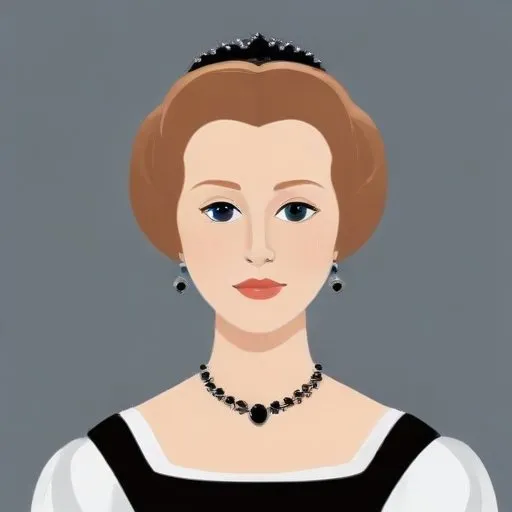
A 16th-century German noblewoman who married into the Pomeranian royal family and played a significant role in promoting the arts and education. She was a patron of the famous astronomer Tycho Brahe.
Sophie of Saxony, Duchess of Pomerania, was a woman of immense strength and character, known for her unwavering determination and resilience in the face of adversity. As a member of the Albertine branch of the House of Wettin, Sophie played a significant role in the tumultuous history of Saxony and Pomerania during the Thirty Years' War.
Born on April 29, 1587, Sophie was the daughter of Elector Christian I of Saxony and Sophie of Brandenburg. Her marriage to Duke Francis of Pomerania-Stettin on August 26, 1610, marked the beginning of her journey as the Duchess of Pomerania. Unfortunately, the marriage remained childless, but Sophie's dedication to her duties and her people remained unwavering.
After Francis' death in 1620, Sophie received the city and district of Wolin as her wittum. During the turbulent years of the Thirty Years' War, Sophie demonstrated exceptional administrative skills, governing the district with determination and wisdom. Between 1622 and 1626, she built a new residence in Wolin, showcasing her resourcefulness and vision.
After Sophie's death on December 9, 1635, the district of Wolin fell back to Duke Bogislaw XIV of Pomerania. However, the Swedish army, which was at war with Saxony, confiscated all movable property, including furniture and grain stocks, considering Sophie a Saxon. Initially buried in the ducal crypt in Szczecin, Sophie's body was later transferred to the Sophienkirche in Dresden in 1650.
Sophie's ancestry can be traced back to her father, Elector Christian I of Saxony, and her mother, Sophie of Brandenburg. Her relatives played significant roles in shaping the history of Saxony and Pomerania, with some notable figures including:
Sophie's life and legacy continue to inspire and fascinate historians and scholars alike. Her determination and resilience in the face of adversity serve as a testament to her strength of character. While the Thirty Years' War ravaged Europe, Sophie's administrative prowess and vision helped maintain stability in Wolin, leaving a lasting impact on the region's history.
Through her life and reign, Sophie of Saxony, Duchess of Pomerania, has left an indelible mark on the annals of history, earning her a place among the most remarkable women of her time.
Did you know that Sophie built a new residence in Wolin between 1622 and 1626, showcasing her resourcefulness and vision?
Sophie's body was initially buried in the ducal crypt in Szczecin before being transferred to the Sophienkirche in Dresden in 1650.
Sophie's wittum, the city and district of Wolin, was confiscated by the Swedish army after her death, considering her a Saxon.
Born in 1585
Ruler of Saxony from 1611 to 1656, known for his role in the Thirty Years' War and his efforts to maintain Saxony's independence. He also supported the arts and architecture, commissioning several notable buildings.
Born in 1526
A 16th-century German ruler who played a key role in the Protestant Reformation and was a strong supporter of the arts, commissioning many notable works of literature and music.
Born in 1441
German ruler of Saxony who introduced the Reformation and played a key role in the early Protestant movement, shaping the course of European history.
Born in 1463
A key figure in the early Protestant Reformation, he protected and supported Martin Luther, providing a safe haven for him to translate the Bible into German. He's also known for his role in establishing the University of Wittenberg.
Born in 1503
Elector of Saxony who played a key role in the Protestant Reformation and was a prominent leader of the Schmalkaldic League, a defensive alliance of Protestant states. He's also known for being captured and imprisoned by Emperor Charles V.
Born in 1515
Ruler of Pomerania from 1531 to 1560, known for his efforts to strengthen the duchy and promote the Protestant Reformation. He played a significant role in shaping the region's politics and religion.
