


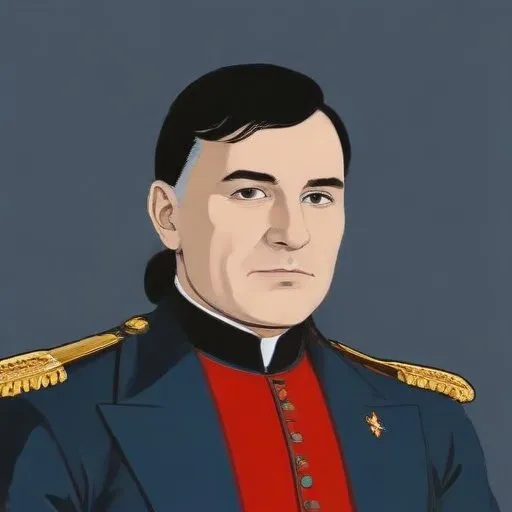
A Confederate general during the American Civil War, known for his bravery and tactical skills, particularly at the Battle of Shiloh.
St. John Richardson Liddell was a prominent Louisiana planter who served as a general in the Confederate States Army during the American Civil War, earning recognition for his outspoken support of Southern emancipation of slaves. His tumultuous life was marked by a feud with a former Confederate officer, Charles Jones, which ultimately led to his tragic demise in 1870.
Born on September 6, 1815, to a wealthy plantation family near Woodville, Mississippi, Liddell was a schoolmate of future Confederate President Jefferson Davis. He attended the United States Military Academy from 1834 to 1835 but resigned prior to graduating. Liddell then moved to Catahoula Parish, establishing his own prosperous plantation, Llanada, near Harrisonburg, Louisiana.
The infamous Jones-Liddell feud, which began in the 1850s, would eventually lead to Liddell's death. The feud was a result of a long-standing animosity between Liddell and Charles Jones, a former Confederate officer. This bitter rivalry would ultimately prove fatal for Liddell.
With the outbreak of the Civil War and Louisiana's secession, Liddell enlisted in the Confederate States Army, receiving a commission. He initially served as a staff officer to his close friend William J. Hardee and Albert Sidney Johnston during the early part of the conflict. Liddell then commanded the famous Arkansas Brigade in Patrick Cleburne's division of the Army of Tennessee from 1862-1863, participating in battles such as Perryville and Murfreesboro.
Liddell's military career was marked by his refusal of promotions to secure assignments closer to his plantation, which was threatened by Jayhawkers. Despite being publicly critical of General Braxton Bragg, Liddell seemed to enjoy his favor, being approached to become his chief of staff.
On February 14, 1870, Liddell's life was brutally cut short when Charles Jones, his longtime rival, murdered him near his home. This tragic event marked the culmination of the Jones-Liddell feud, which had been simmering for years.
St. John Richardson Liddell's life was marked by controversy, conflict, and ultimately, tragedy. Despite his tumultuous career, Liddell remains an important figure in American history, remembered for his advocacy of Southern emancipation and his complex role in the Civil War.
Through his life, Liddell navigated the treacherous waters of war, feuds, and social change, leaving behind a legacy that continues to fascinate and educate historians and enthusiasts alike.
Born in 1807
Led the Confederate States Army during the American Civil War, surrendering to Union forces at Appomattox, marking the war's effective end.
Born in 1822
Led the Union Army to victory in the Civil War and later became President, known for issuing the Emancipation Proclamation and strengthening federal authority.
Born in 1820
A renowned Union general during the American Civil War, he's infamous for his scorched earth tactics and march through the Confederacy, leaving destruction in his wake.
Born in 1826
A Union general during the American Civil War, he's infamous for his cautious tactics and disagreements with President Lincoln, later becoming a governor of New Jersey.
Born in 1824
A Union general during the American Civil War, known for his distinctive sideburns and leading the Army of the Potomac to a disastrous defeat at the Battle of Fredericksburg.
Born in 1814
Union general who played a crucial role in the American Civil War, particularly at the Battle of Chancellorsville and Gettysburg.
Born in 1815
Led the Union Army to victory in the Battle of Gettysburg, a turning point in the American Civil War, and later oversaw the construction of the Washington Aqueduct.
Born in 1822
Union general during the American Civil War, known for his disastrous defeat at the Second Battle of Bull Run. He was relieved of his command and later served in the Indian Wars.
