


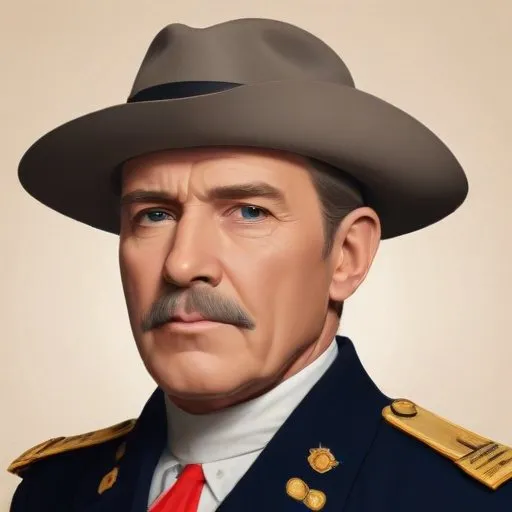
A prominent Confederate general during the American Civil War, known for his tactical prowess and authoring a widely-used military textbook.
William Joseph Hardee, a career U.S. Army and Confederate States Army officer, is renowned for his groundbreaking military tactics and leadership during the American Civil War. His influential writings on military strategy were widely studied and employed by both Union and Confederate forces, earning him the reputation as one of the most skilled military minds of his time.
Born on October 12, 1815, at the Rural Felicity Plantation in Camden County, Georgia, Hardee was the son of Sarah Ellis and Major John Hais Hardee Jr. One of his brothers, Noble Hardee, would later become a prominent Savannah merchant. Hardee graduated from the United States Military Academy at West Point in 1838, ranking 26th in a class of 45, and was commissioned as a second lieutenant in the 2nd U.S. Dragoons.
During the Seminole Wars (1835-1842), Hardee contracted an illness and was hospitalized, where he met and married Elizabeth Dummett. After his recovery, the Army sent him to France to study military tactics in 1840. His military career flourished, with promotions to first lieutenant in 1839, captain in 1844, and brevet major for his bravery in the Mexican-American War.
Hardee served in the Army of Occupation under Zachary Taylor and won two brevet promotions for his actions in Mexico. However, he was captured by Mexican troops on April 25, 1846, during the Thornton Affair, along with Seth Thornton and their men. He was exchanged on May 11, 1846, and continued to serve under Winfield Scott, where he was wounded in a skirmish at La Rosia, Mexico, in 1847.
At the outbreak of the American Civil War, Hardee sided with the Confederacy and became a general. He served in the Western Theater, where he clashed with commanding officers Braxton Bragg and John Bell Hood. Despite these conflicts, Hardee played a crucial role in the Atlanta Campaign of 1864 and the Carolinas Campaign of 1865. He surrendered with General Joseph E. Johnston to William Tecumseh Sherman in April 1865.
Hardee's writings on military tactics, particularly his book "Rifle and Light Infantry Tactics," were widely used by both Union and Confederate forces during the Civil War. His work continued to influence military strategy for generations to come, solidifying his position as one of the most important military thinkers of the 19th century.
William J. Hardee's remarkable military career, marked by bravery, strategic brilliance, and controversy, continues to inspire and educate military historians and strategists to this day.
Born in 1807
Led the Confederate States Army during the American Civil War, surrendering to Union forces at Appomattox, marking the war's effective end.
Born in 1822
Led the Union Army to victory in the Civil War and later became President, known for issuing the Emancipation Proclamation and strengthening federal authority.
Born in 1820
A renowned Union general during the American Civil War, he's infamous for his scorched earth tactics and march through the Confederacy, leaving destruction in his wake.
Born in 1821
A Confederate general during the American Civil War, later serving as a diplomat and ambassador to Turkey, known for his military strategies and post-war reconciliation efforts.
Born in 1818
A Confederate general who played a pivotal role in the American Civil War, particularly during the Battle of Fort Sumter, and is often credited with starting the war.
Born in 1817
A Confederate general during the American Civil War, he's infamous for his tactical blunders and defeats, ultimately losing the war for the South.
Born in 1825
A Confederate general during the American Civil War, known for his bravery and tactical skills, leading troops in several key battles, including the Battle of Chancellorsville.
Born in 1831
A Confederate general during the American Civil War, known for his bravery and aggressive tactics, but also criticized for his reckless decisions that led to devastating defeats.
