


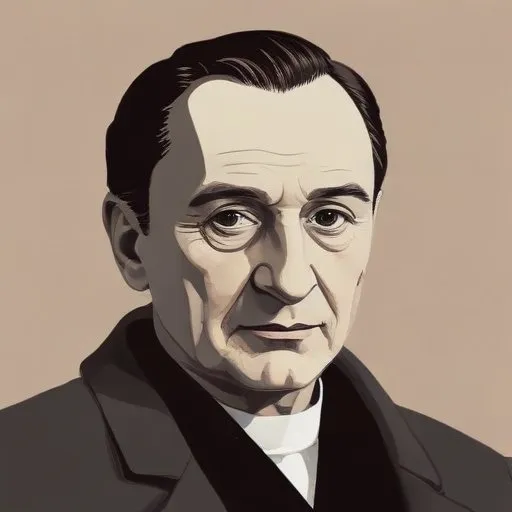
A Polish poet and critic who developed the concept of "Awangarda Krakowska" (Krakow Avant-Garde), a literary movement that emphasized the importance of form and language in poetry. He's known for his innovative and influential poetry collections that explored the relationship between words and meaning.
Tadeusz Peiper, a Polish poet, art critic, and theoretician of literature, is renowned for being one of the precursors of the avant-garde movement in Polish poetry. His pioneering work in the early 20th century paved the way for young poets and shaped the landscape of Polish literature.
Born on May 3, 1891, to a Jewish family, Peiper's early life was marked by a sense of restlessness. He converted to Catholicism as a young man and spent several years in Spain, where he was exposed to the works of Spanish avant-garde poets. This experience had a profound impact on his writing style, which became a unique blend of traditionalism and innovation.
In 1921, Peiper co-founded the Awangarda krakowska (Krakow Avant-Garde) group of writers, a collective that sought to revolutionize Polish poetry. The same year, he founded the monthly magazine Zwrotnica (Railroad Switch), which became a platform for avant-garde movements in contemporary poetry. Although the magazine was short-lived, it played a crucial role in promoting the works of young poets, including Julian Przybo, Jan Brzkowski, and Jalu Kurek.
Peiper's poetry collections, such as Rzuty (1922), Zmienneulia (1924), and Krzywa szyba (1929), are considered some of the most notable pieces of constructivist Polish poetry. He believed that a writer should resemble a skilled craftsman, carefully planning each word to create a unique literary experience. His famous 3 x M slogan – Miasto, Masa, Maszyna (City, Mass, Machine) – became a rallying cry for Polish poets of the 1920s, emphasizing the importance of industrialization and urbanization in modern life.
After World War II, Peiper continued to write, publishing articles in Tygodnik Powszechny about Adam Mickiewicz, a prominent Polish poet. He worked as an editor for Jerzy Borejsza until his retirement. Throughout his life, Peiper remained committed to his artistic vision, inspiring generations of Polish poets and leaving an indelible mark on the country's literary landscape.
Tadeusz Peiper's legacy extends beyond his poetry and literary criticism. He played a vital role in shaping the cultural identity of Poland, inspiring a new generation of artists and writers to experiment with form and style. Today, he is remembered as a true original, a maverick who refused to be bound by convention and instead forged his own path in the world of Polish literature.
Born in 1904
A Polish literary mastermind, celebrated for his avant-garde novels and plays that probed the human condition, identity, and the search for meaning. His works are a blend of philosophical inquiry, psychological insight, and dark humor.
Born in 1894
A renowned Polish literary figure, celebrated for his innovative and humorous poetry, plays, and theatrical direction, which continue to inspire and entertain audiences.
Born in 1878
A Ukrainian-Polish poet and academic who made significant contributions to 20th-century Polish literature, exploring themes of existentialism and modernity. Their work is characterized by its lyricism and philosophical depth.
Born in 1847
A pioneering journalist and author who explored social issues and championed realism in Polish literature, leaving a lasting impact on the country's literary scene.
Born in 1846
A Polish journalist and author who wrote epic historical novels, including "Quo Vadis", which won him the Nobel Prize in Literature in 1905. His works are known for their vivid storytelling and historical accuracy.
