


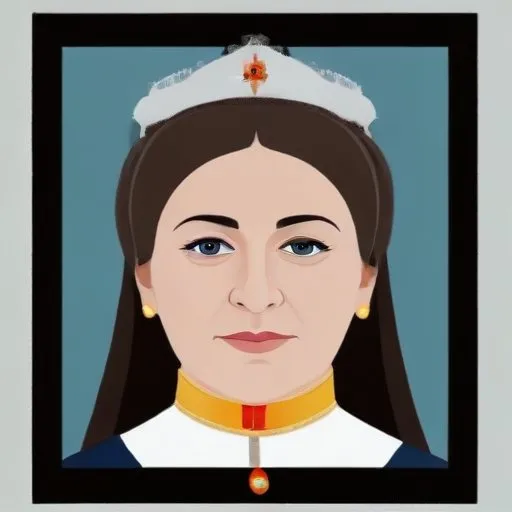
The last queen of Portugal, known for her strong will and dedication to her country, playing a crucial role in the country's transition from monarchy to republic.
Teresa Cristina of the Two Sicilies, affectionately known as the "Mother of the Brazilians," was the Empress of Brazil alongside her husband Emperor Dom Pedro II from 1843 to 1889. She was a devoted spouse, a patron of the arts and sciences, and a beloved figure in Brazilian society.
Born on March 14, 1822, in Naples, Italy, Teresa Cristina was a princess of the Kingdom of the Two Sicilies. She was the daughter of King Francesco I of the Italian branch of the House of Bourbon and his wife Maria Isabel. Historians initially believed that Teresa Cristina was raised in an ultra-conservative environment, which led to her timid and unassertive nature. However, recent studies have revealed a more complex character, one who valued learning, sciences, and culture, and was able to assert her independence despite the societal norms of the era.
In 1843, Teresa Cristina was married by proxy to Emperor Dom Pedro II of Brazil. The Emperor's expectations were initially dashed when he met his bride, as she did not conform to the idealized beauty depicted in her portrait. However, the couple's relationship improved over time, thanks to Teresa Cristina's kindness, patience, and generosity. These qualities not only won the heart of her husband but also endeared her to the Brazilian people.
As Empress, Teresa Cristina remained largely apolitical, avoiding controversy and public criticism. Instead, she focused on her role as a patron of the arts and sciences, sponsoring archaeological studies in Italy and promoting Italian immigration to Brazil. Her distance from political controversies allowed her to maintain a positive public image, earning her the love and respect of the Brazilian people.
The marriage between Teresa Cristina and Emperor Dom Pedro II was not passionately romantic, but rather a bond based on mutual respect, family, and fondness. The Empress was a dutiful spouse, supporting her husband's positions without ever publicly expressing her own views. Despite this, she remained a strong-willed individual with a passion for learning and culture.
Teresa Cristina's legacy extends beyond her role as Empress. She played a significant role in promoting cultural exchange between Italy and Brazil, fostering a strong and lasting bond between the two nations. Her patronage of the arts and sciences also contributed to Brazil's cultural development, earning her a place in the country's history as a beloved and respected figure.
Teresa Cristina's values and beliefs were shaped by her upbringing and her role as Empress. She valued education, culture, and the arts, recognizing their importance in shaping a nation's identity and progress. Her commitment to these values inspired a generation of Brazilians, leaving a lasting impact on the country's cultural landscape.
Teresa Cristina's life and legacy are a testament to the complex and multifaceted nature of women's roles in history. As Empress, she navigated the complexities of royal politics while remaining true to her values and passions. Her story serves as a powerful inspiration, reminding us of the importance of education, culture, and mutual respect in shaping a nation's identity and progress.
Teresa Cristina of the Two Sicilies passed away on December 28, 1889, at the age of 67. Her legacy lives on, a testament to the power of kindness, generosity, and devotion to family, culture, and nation.
Born in 1751
King of the Two Sicilies from 1816 to 1825, known for his efforts to unify Italy and his role in the country's struggle for independence.
Born in 1836
Last king of the Two Sicilies, ruling from 1859 to 1861, known for his brief and tumultuous reign that ended with the unification of Italy.
Born in 1820
Unified Italy's first king, who played a key role in the country's unification and modernization. He's remembered for his strong leadership and diplomatic skills.
Born in 1844
King of Italy from 1878 to 1900, known for unifying Italy and establishing the modern Italian state. He played a key role in Italian politics and foreign policy during his reign.
Born in 1793
Emperor of Austria from 1835 to 1848, known for his role in the Revolutions of 1848 and his abdication in favor of his nephew Franz Joseph.
Born in 1835
A brutal colonialist who exploited the Congo Free State for rubber and ivory, causing millions of deaths and atrocities. His reign was marked by greed, violence, and human rights abuses.
