


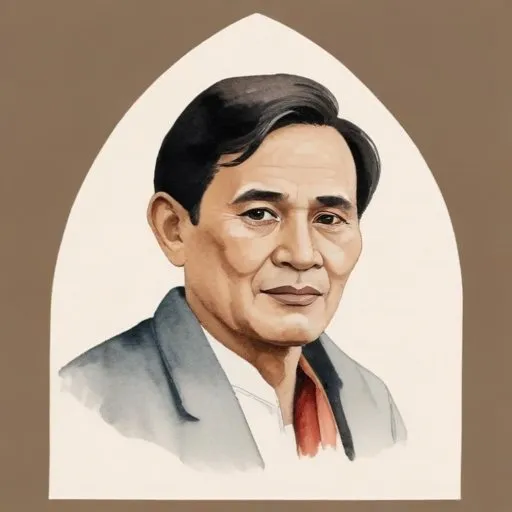
A renowned Burmese poet, writer, and political leader who played a significant role in shaping the country's modern literature and independence movement. He is celebrated for his powerful writings that inspired a generation of Burmese people to fight for freedom and democracy.
Thakin Kodaw Hmaing is renowned as one of the most influential Burmese poets, writers, and political leaders of the 20th century. He is celebrated as the Father of Burmese nationalist and peace movements, leaving an indelible mark on the country's literature and politics.
Born as Maung Lun Maung on March 23, 1876, in Wale village, Lower Burma, Hmaing was sent to Mandalay for traditional education at a young age. At just 9 years old, he witnessed the fall of the Konbaung dynasty and the British abduction of King Thibaw and Queen Supayalat, an event that sparked his nationalist fervor and lifelong struggle for independence.
In 1894, Hmaing moved to Rangoon (now Yangon) to pursue a career as a playwright and journalist. He wrote articles for a newspaper in Moulmein (now Mawlamyaing) before returning to the capital in 1911 to work for the Thuriya Sun newspaper. Writing under his own name, Maung Lun or Saya Lun, he gained widespread recognition through his traditional stage plays written in verse, based on historical Burmese myth and legend.
Hmaing's mastery of classical Burmese literature enabled him to write extensively in verse with ease and flair, setting a high standard for future generations of writers. He contributed regularly to various publications, including the Dagon magazine, where he later became an editor.
As a key figure in the nationalist movement, Hmaing's writings and actions played a significant role in inspiring the fight for independence. He was a strong advocate for peace and unity, using his influence to promote dialogue and cooperation among diverse groups.
Through his literary works and public speeches, Hmaing emphasized the importance of national unity, social justice, and economic development. His vision for a united and independent Burma continues to inspire generations of Burmese people.
Thakin Kodaw Hmaing's legacy extends far beyond his literary and political achievements. He is remembered as a symbol of national pride, and his influence can still be felt in both literature and politics in Myanmar (Burma) today.
Hmaing's work has inspired numerous writers, poets, and artists, shaping the country's cultural landscape. His commitment to peace and nationalism has influenced political movements and continues to inspire activists and leaders.
Thakin Kodaw Hmaing's contributions to Burmese literature and politics have been recognized with numerous awards and honors. He is celebrated as a national hero, and his works continue to be widely studied and revered.
Today, Hmaing's legacy serves as a beacon of hope for a unified and peaceful Myanmar (Burma), inspiring future generations to strive for a brighter future.
81 Years Old
A democracy icon and human rights activist, she led the fight against Myanmar's military rule and was awarded the Nobel Peace Prize in 1991.
Born in 1909
A Burmese educator and diplomat who served as the 3rd United Nations Secretary-General, mediating international conflicts and promoting global cooperation. He's known for his quiet diplomacy and leadership during the Cold War era.
Born in 1910
A Burmese army general and politician who ruled the country with an iron fist, implementing isolationist and nationalist policies that led to economic stagnation and human rights abuses.
Born in 1893
A Burmese lawyer and politician who served as Prime Minister of Burma, leading the country to independence from British colonial rule and playing a key role in shaping its early years. He's also known for his efforts to promote national unity and reconciliation.
Born in 1915
Led the fight for Burmese independence from British colonial rule and is considered the founder of modern Burma. He was assassinated before independence was achieved, but his daughter Aung San Suu Kyi continued his legacy.
Born in 1907
First Prime Minister of Burma, leading the country to independence from British colonial rule and establishing a democratic government. He's also known for his efforts to promote Buddhism and national unity.
