


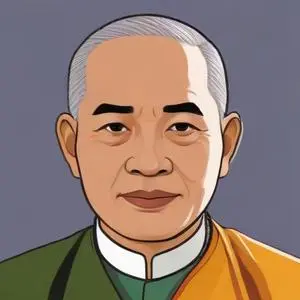
Led the fight for Burmese independence from British colonial rule and is considered the founder of modern Burma. He was assassinated before independence was achieved, but his daughter Aung San Suu Kyi continued his legacy.
Aung San, widely regarded as the founder of modern-day Myanmar and the Tatmadaw (the country's armed forces), played a pivotal role in the country's struggle for independence from British rule. He is remembered as the "Father of the Nation," "Father of Independence," and "Father of the Tatmadaw," a testament to his profound impact on Myanmar's history.
Aung San's commitment to ending British colonial rule in Burma was unwavering. He founded or was closely associated with numerous Burmese political groups and movements, exploring various schools of thought, including socialism, throughout his life. As a student, he was elected to the executive committee of the Rangoon University Students Union and served as the editor of its newspaper, demonstrating his early passion for leadership and social change.
In 1938, Aung San joined the Thakin Society, serving as its general secretary. He also played a key role in establishing the Communist Party of Burma in 1939, although he soon parted ways with the party due to disagreements with its leadership. Undeterred, he co-founded the People's Revolutionary Party (later known as the Burma Socialist Party), with the primary goal of achieving Burmese independence from the British.
On the eve of World War II, Aung San fled to China to solicit foreign support for Burma's independence. During the Japanese occupation of Burma, he served as the Minister of War in the Japan-backed State of Burma, led by Dr. Ba Maw. As the tide turned against Japan, Aung San switched sides, merging his forces with the Allies to fight against the Japanese. This tactical shift ultimately contributed to Japan's defeat.
In the aftermath of World War II, Aung San negotiated Burma's independence from Britain in the Aung San-Attlee Agreement. He subsequently served as the 5th Premier of the British Crown Colony of Burma. Tragically, Aung San's life was cut short by assassination on July 19, 1947, just six months before his goal of independence was realized. Despite this, his legacy endured, and he remains a revered figure in Myanmar's history.
Aung San's contributions to Myanmar's struggle for independence and his enduring legacy have been recognized through various honors and awards. He is celebrated as a national hero, and his birthday, February 13, is observed as a public holiday in Myanmar.
Aung San's life and achievements are deeply intertwined with Myanmar's struggle for independence and its modern-day development. His vision for a unified and independent Burma continues to inspire generations, earning him a revered place in the country's history.
81 Years Old
A democracy icon and human rights activist, she led the fight against Myanmar's military rule and was awarded the Nobel Peace Prize in 1991.
Born in 1910
A Burmese army general and politician who ruled the country with an iron fist, implementing isolationist and nationalist policies that led to economic stagnation and human rights abuses.
Born in 1909
A Burmese educator and diplomat who served as the 3rd United Nations Secretary-General, mediating international conflicts and promoting global cooperation. He's known for his quiet diplomacy and leadership during the Cold War era.
Born in 1893
A Burmese lawyer and politician who served as Prime Minister of Burma, leading the country to independence from British colonial rule and playing a key role in shaping its early years. He's also known for his efforts to promote national unity and reconciliation.
Born in 1907
First Prime Minister of Burma, leading the country to independence from British colonial rule and establishing a democratic government. He's also known for his efforts to promote Buddhism and national unity.
93 Years Old
A Burmese general and politician who served as the Prime Minister of Burma from 1992 to 2011, known for his authoritarian rule and human rights abuses.
81 Years Old
A former general who led Myanmar's transition from military rule to democracy, known for his reforms and release of political prisoners.
