


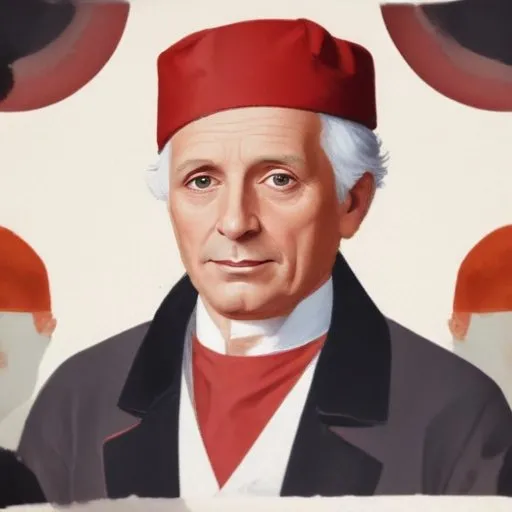
A 17th-century physician who pioneered the development of modern pharmacology and wrote extensively on medicine, chemistry, and natural history.
Sir Théodore de Mayerne, a renowned Genevan-born physician, left an indelible mark on the medical fraternity by treating the who's who of 17th-century European royalty, including kings of France and England. His groundbreaking work on Paracelsus' theories not only advanced the field of medicine but also earned him the esteemed position of royal physician to two prominent European monarchs.
Born on September 28, 1573, in a Huguenot family in Geneva, Republic of Geneva, Mayerne's early life was shaped by his father, a Protestant French historian who had fled Lyon following the St. Bartholomew's Day Massacre. His godfather, Theodore Beza, played a significant role in instilling in him a strong sense of Calvinism, which would later influence his medical practices.
Mayerne's academic pursuits took him from Geneva to the University of Heidelberg and eventually to Montpellier, where he studied medicine under the guidance of Joseph du Chesne. His 1597 doctoral dissertation, which defended the use of chemical remedies in medicine, showcased his keen interest in Paracelsian theories, a fascination that would remain a hallmark of his career.
In May 1599, Mayerne embarked on a grand tour of Europe with Henri de Rohan, a powerful Huguenot nobleman, visiting Germany, Italy, Bohemia, the Netherlands, England, and Scotland. This journey exposed him to the rich cultural heritage of Europe, and he was particularly drawn to the works of Albrecht Dürer and the Kunstkammer in Munich, showcasing the curiosities kept by the Duke of Bavaria.
During their visit to London in October 1600, Mayerne and Rohan were received by Queen Elizabeth I at her court, and in November 1600, they met King James VI of Scotland in Edinburgh. These royal encounters paved the way for Mayerne's future as a royal physician, a position he would hold with great distinction.
Mayerne's move to Paris marked the beginning of his illustrious medical practice. He lectured on anatomy and pharmacy, gaining a reputation for his innovative approaches to medicine, including his support for Paracelsus' theories. His detailed notes on patients, including the likes of Armand du Plessis, later Cardinal Richelieu, whom he treated for gonorrhea in 1605, demonstrate his dedication to his craft.
Sir Théodore de Mayerne's contributions to medicine went beyond his royal connections. He championed the use of chemical remedies, bridging the gap between alchemy and medicine. His work paved the way for future generations of physicians, solidifying his position as a pioneer in the field of medicine.
Sir Théodore de Mayerne's remarkable life serves as a testament to his unwavering dedication to the field of medicine. As a royal physician, he transcended borders and dynasties, leaving behind a legacy that continues to inspire and influence medical practitioners to this day.
Born in 1578
Discovered the circulatory system and described how blood flows through the body, revolutionizing understanding of human physiology.
Born in 1561
A 16th-17th century Renaissance figure who pioneered the scientific method and empiricism, and served as a prominent government official.
Born in 1514
A pioneering figure in the study of human anatomy, known for performing detailed dissections and creating accurate drawings of the body's inner workings, revolutionizing medical understanding.
Born in 1596
Developed influential philosophical and mathematical concepts, including the famous phrase "I think, therefore I am," and laid the foundation for modern Western philosophy.
