


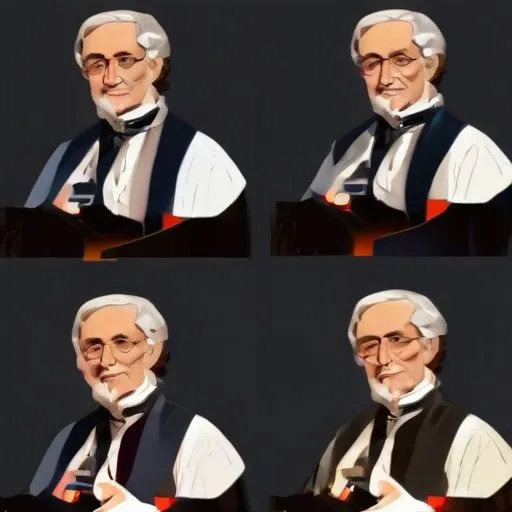
A 16th-century physician and theologian who challenged the authority of the Church, advocating for the separation of church and state, and influencing the development of modern democracy.
Thomas Erastus, a Swiss physician and Calvinist theologian, is best known for his 100 theses, later reduced to 75, which argued that the state, not the church, should punish Christians for their sins. This groundbreaking work, published posthumously in 1589, formed the foundation of Erastianism, a significant theological movement.
Born on September 7, 1524, in Baden, canton of Aargau, Switzerland, Erastus came from humble beginnings. His parents, though poor, encouraged his pursuit of knowledge, leading him to study theology at the University of Basel in 1540. The plague of 1544 prompted Erastus to relocate to the University of Bologna and later to the University of Padua, where he delved into philosophy and medicine.
Erastus's intellectual prowess earned him recognition, and in 1553, he became the physician to the count of Henneberg, Saxe-Meiningen. Five years later, he held the same position with the elector-palatine, Otto Heinrich, while serving as a professor of medicine and pharmacology at the University of Heidelberg until 1580. During this period, Anselmus Boetius de Boodt was among his notable students.
Erastus's theological stance was deeply rooted in the teachings of Huldrych Zwingli. At the sacramentarian conferences of Heidelberg (1560) and Maulbronn (1564), he passionately advocated for the Zwinglian doctrine of the Lord's Supper. In 1565, he responded to counterarguments from Johann Marbach, a Lutheran theologian from Strasbourg.
Erastus's resistance to the introduction of the Presbyterian polity and discipline, led by Caspar Olevian, resulted in his excommunication by the Calvinists in 1570. The ban was only lifted in 1575, after Erastus reaffirmed his commitment to the doctrine of the Trinity. This controversy, though tumultuous, did not diminish his contributions to Calvinist thought.
Erastus's work had a profound impact on the development of church-state relations. His ideas continue to influence modern debates on the role of religion in governance. Furthermore, his emphasis on the state's responsibility to punish sin has sparked discussions on the limits of religious authority.
Through his life's work, Thomas Erastus demonstrated a commitment to theological scholarship and a willingness to challenge prevailing norms. His legacy continues to shape our understanding of church-state relations and the role of religion in modern society.
Born in 1519
A 16th-century French theologian and scholar who played a key role in shaping Protestantism, particularly Calvinism, through his writings and teachings. He's also known for his Greek New Testament translation.
Born in 1509
A French pastor and theologian who played a key role in the Protestant Reformation, shaping Christian theology and influencing Western civilization. He's famous for his teachings on predestination and his role in establishing Calvinism.
Born in 1484
Leader of the Swiss Reformation, advocating for church reform and inspiring other Protestant movements.
Born in 1483
A German monk and priest who sparked the Protestant Reformation, challenging Catholic Church authority and shaping Western Christianity. He's famous for nailing 95 theses to a church door, sparking a religious revolution.
Born in 1497
A 16th-century Renaissance scholar who made significant contributions to the development of the Protestant Reformation and education, known for his theological writings and astronomical observations.
Born in 1504
A prominent figure in the Swiss Reformation, he played a key role in shaping Protestant theology and wrote influential works on covenant theology. His writings had a lasting impact on Reformed Christianity.
