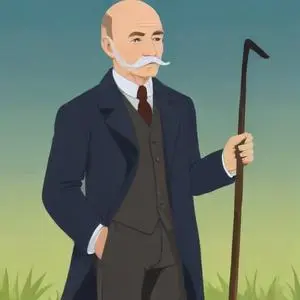
Thomas Hardy: A Pillar of Victorian Realism and 20th-Century Literature
A Novelist and Poet of Unyielding Critical Acclaim
Thomas Hardy, a luminary of Victorian realism, is renowned for his poignant and thought-provoking novels and poetry that continue to captivate audiences to this day. He is best known for his tragic characters struggling against their passions and social circumstances, which are often set in the semifictional region of Wessex, a locale inspired by the medieval Anglo-Saxon kingdom.
Early Life and Education
Born on June 2, 1840, in Higher Bockhampton, Dorset, England, Hardy was the son of Thomas Hardy, a stonemason and local builder, and Jemima Hand Hardy, a well-read woman who educated him until he attended his first school at the age of eight. This foundation in literature and learning laid the groundwork for his future literary pursuits.
Career Highlights and Major Works
Hardy's literary career spanned several decades and genres, with his most notable works including:
- Far from the Madding Crowd (1874), a novel that explores the complexities of rural life and relationships
- The Mayor of Casterbridge (1886), a tragic tale of love, betrayal, and redemption
- Tess of the d'Urbervilles (1891), a heart-wrenching novel that critiques the social conventions of Victorian society
- Jude the Obscure (1895), a novel that examines the struggles of the working class and the constraints of societal expectations
In addition to his novels, Hardy was a prolific poet, with his first collection published in 1898. His poetry was hailed by younger poets, including the Georgians, who viewed him as a mentor. Notable poets such as
Ezra Pound, W.H. Auden, and
Philip Larkin have also praised Hardy's poetry.
Influence on Modern Society and Pop Culture
Hardy's works have had a significant impact on modern society and popular culture. His novels have been adapted into numerous film, television, and stage productions, introducing his stories to new generations of audiences. His critiques of Victorian society continue to resonate with contemporary audiences, offering a window into the social and cultural norms of the time.
Philosophical Contributions and Beliefs
Hardy's writing is characterized by a strong sense of social commentary and critique. He was deeply concerned with the declining status of rural people in Britain, particularly in his native South West England. His works often explore themes of fate, morality, and the human condition, reflecting his philosophical stance on the role of individuals in society.
Personal Milestones and Key Life Events
Hardy's personal life was marked by several significant events, including his marriage to Emma Lavinia Gifford in 1874 and the death of his first wife in 1912. He married Florence Dugdale in 1914, who survived him until her death in 1937. Hardy passed away on January 11, 1928, leaving behind a legacy of literary masterpieces that continue to captivate audiences today.
Legacy and Historical Context
Thomas Hardy's works are a testament to his literary genius and his ability to capture the essence of Victorian society. His novels and poetry continue to be widely studied, admired, and adapted, cementing his place as one of the most significant literary figures of the 20th century. His legacy serves as a reminder of the power of literature to critique, reflect, and shape our understanding of the world around us.
FAQ
What theme is common in Thomas Hardys novels?
Thomas Hardys novels often explore the theme of the human struggle against the forces of nature, fate, and society, with many of his works featuring rural settings and exploring the lives of ordinary people.
What is Thomas Hardys most famous novel?
Thomas Hardys most famous novel is probably Tess of the dUrbervilles, published in 1891, which tells the story of a young womans tragic life in rural England.
What was Thomas Hardys childhood like?
Thomas Hardy was born in 1840 in Dorset, England, and grew up in a rural area, which had a significant impact on his writing and his fascination with the natural world.
What was Thomas Hardys relationship like with his wife?
Thomas Hardy was married to Emma Lavinia Gifford, and their relationship was marked by a deep love and mutual respect, but also by periods of tension and conflict.
What is Thomas Hardys legacy in English literature?
Thomas Hardys legacy in English literature is marked by his innovative use of language, his exploration of themes such as nature, fate, and society, and his creation of memorable characters, making him one of the greatest novelists of the late 19th and early 20th centuries.