


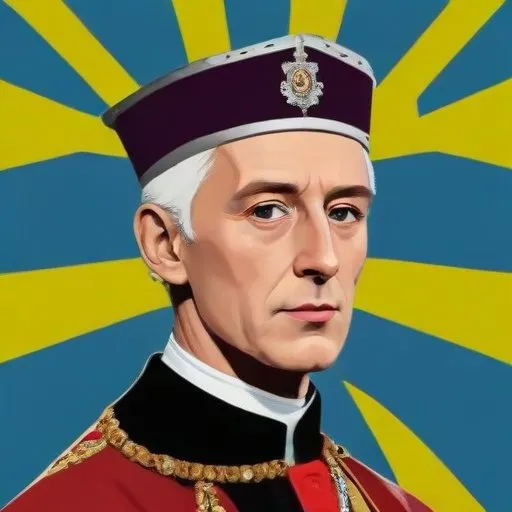
A powerful nobleman who held significant influence over English politics and served as Lord High Constable of England, known for his role in the Lords Appellant rebellion against King Richard II.
Thomas of Woodstock, Duke of Gloucester, was a formidable figure in medieval England, known for his military prowess, political influence, and tumultuous relationships with the royal family. As the fifth surviving son of King Edward III and Philippa of Hainault, Thomas carved out his own path in history, earning both admiration and fear from his contemporaries.
Born on January 7, 1355, at Woodstock Palace in Oxfordshire, Thomas was raised alongside his numerous siblings, including the Black Prince. In 1374, he married Eleanor de Bohun, a union that brought him wealth, title, and influence. The marriage also strengthened ties between the royal family and the powerful de Bohun family, securing Thomas' position as a rising star in the English aristocracy.
In 1377, at the age of 22, Thomas was knighted and created Earl of Buckingham. His military career took off soon after, with his appointment as Constable of the Realm, a position previously held by the Bohuns. As Earl of Essex, Thomas led a large campaign in northern France, supporting John IV, Duke of Brittany, in his struggle against Charles of Blois. The campaign, though marked by controversy and strategic challenges, demonstrated Thomas' tactical prowess and earned him recognition as a skilled military leader.
Thomas' political influence continued to grow, with his creation as Duke of Aumale in 1385 and, shortly after, Duke of Gloucester. These titles solidified his position as a powerful nobleman, with extensive lands, wealth, and authority in England and beyond.
Thomas' relationships with his family members were often tumultuous, particularly with his nephew, King Richard II. The two engaged in a bitter power struggle, with Thomas eventually becoming a leader of the Lords Appellant, a group of nobles opposed to Richard's rule. This conflict ultimately led to Thomas' downfall and mysterious death in 1397.
Thomas of Woodstock, Duke of Gloucester, left an indelible mark on English history. His military campaigns, although not always successful, showcased his bravery and strategic thinking. His rise to power, though marred by controversy, demonstrated his ambition and tenacity. As a complex figure, Thomas remains an intriguing subject for historians and enthusiasts alike, offering a glimpse into the tumultuous world of medieval politics and royalty.
Born in 1367
The last king of the House of Plantagenet, deposed in a coup, known for his extravagance and tyranny, leading to his downfall and the rise of the Lancastrian dynasty.
Born in 1340
A powerful and wealthy medieval English nobleman, known for his immense influence on English politics and his role in the Hundred Years' War. He was also a patron of the arts and a founder of Trinity College, Cambridge.
Born in 1330
The eldest son of King Edward III, he was a renowned military leader and heir to the English throne, famous for his victories in the Hundred Years' War, particularly the Battle of Poitiers. He was also known for his chivalry and founding the Order of the Garter.
Born in 1362
A 13th-century nobleman who held the title of Duke of Ireland and was a favorite of King Richard II, known for his lavish spending and failed military campaigns.
