


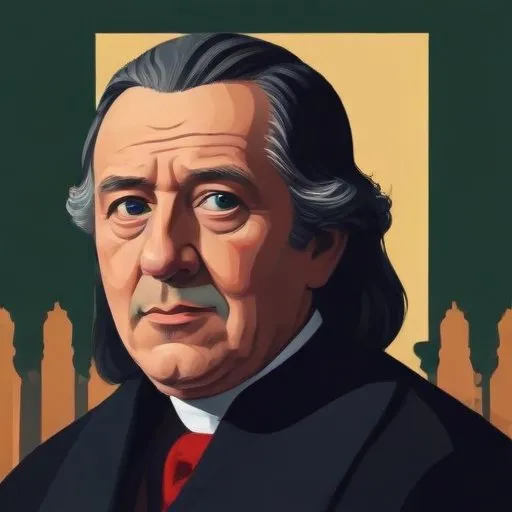
An English minister who fabricated a conspiracy theory about a Catholic plot to overthrow the government, sparking widespread hysteria and persecution of Catholics. He is infamous for his deceit and the harm it caused.
Titus Oates is infamously known for concocting the Popish Plot, a fictional Catholic conspiracy to assassinate King Charles II of England in 1678. This elaborate web of lies led to a wave of anti-Catholic hysteria, resulting in the execution of at least 22 innocent people and the persecution of countless others.
Titus Oates was born on September 15, 1649, in Oakham, Rutland, to Samuel Oates, a minister who oscillated between the Church of England and the Baptists. Oates' education began at Merchant Taylors School and continued at Cambridge University, where he attended Gonville and Caius College and later St John's College. Despite his lack of academic prowess, Oates leveraged his good memory to gain a licence to preach from the Bishop of London.
Oates' clerical career was marred by scandal and controversy. He was ordained as a priest in 1670 and served as vicar of Bobbing in Kent and curate to his father in Hastings. During this time, he falsely accused a schoolmaster of sodomy, hoping to secure the position for himself. The charge was later proved false, and Oates faced perjury charges, narrowly escaping jail.
In 1675, Oates became a chaplain in the Royal Navy, serving on the HMS Adventure. His time in the Navy was short-lived, as he was accused of buggery while in English Tangier and was dismissed from service in 1676.
In August 1678, Oates fabricated a complex plot, alleging that Catholics were planning to assassinate King Charles II. He claimed to have received information from a mysterious figure, "Eustace Comyns," and produced a series of pamphlets detailing the supposed conspiracy.
The public was electrified by Oates' revelations, and anti-Catholic sentiment reached a fever pitch. The government, eager to capitalize on the hysteria, launched a series of trials and executions, with Oates as the star witness. The plot's alleged masterminds, including several prominent Catholics, were executed, and many others were imprisoned or forced into exile.
In 1685, Oates' web of lies began to unravel. He was arrested and tried for perjury, and his lies were exposed in court. Imprisoned and pilloried, Oates spent the remainder of his life in and out of jail, ostracized by society and shunned by his former allies.
Titus Oates' legacy is one of deceit and destruction. His fabrications led to the deaths of innocent people and perpetuated anti-Catholic sentiment for generations to come. Despite his notoriety, Oates remains a cautionary tale about the dangers of unchecked ambition and the devastating consequences of lying.
Titus Oates' name is forever etched in the annals of history as a reminder of the devastating power of deception and the importance of seeking truth in the face of hysteria.
Born in 1656
Predicted celestial events, including the return of a comet that bears his name, and made significant contributions to navigation, astronomy, and mathematics.
Born in 1627
Pioneering scientist who discovered Boyle's Law, which describes the relationship between pressure and volume of gases, and laid foundations for modern chemistry.
Born in 1632
A renowned 17th-century polymath who made groundbreaking contributions to physics, mathematics, and architecture, designing iconic landmarks like St Paul's Cathedral. Their innovative works continue to inspire and influence modern architecture and design.
Born in 1631
A dominant literary figure of the Restoration era, known for his influential poetry, plays, and critical essays that shaped the English literary landscape. He's often credited with creating a new style of heroic drama and satire.
Born in 1628
A 17th-century Puritan minister and writer who penned influential allegorical novels, including "The Pilgrim's Progress", which remains a beloved classic in Christian literature.
