


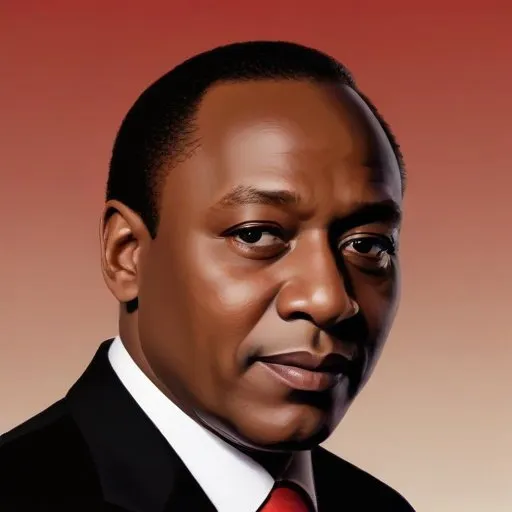
The 4th President of Kenya, serving from 2013 to 2022, known for his efforts to strengthen the country's economy and infrastructure, and his role in shaping Kenya's political landscape.
Uhuru Kenyatta is a Kenyan politician who served as the fourth president of Kenya from 2013 to 2022, making him one of the longest-serving presidents in the country's history. He is known for being the son of Jomo Kenyatta, Kenya's first president, and for his efforts to promote economic development and national unity in Kenya.
Uhuru Kenyatta was born on October 26, 1961, to Jomo Kenyatta and his fourth wife, Mama Ngina Kenyatta. He attended St. Mary's School in Nairobi and later went to Amherst College in Massachusetts, USA, where he graduated with a degree in economics in 1985.
Kenyatta's political career began in 1999 when he was appointed as the chairman of the Kenya Tourism Board. He later became a member of parliament for Gatundu South in 2002 and served as Deputy Prime Minister to Raila Odinga from 2008 to 2013. In 2012, he resigned from the Kenya Africa National Union (KANU) and joined The National Alliance (TNA), which later merged with the United Republican Party (URP) to form the Jubilee Party.
In 2013, Kenyatta won the presidential election and became the fourth president of Kenya. He was re-elected for a second and final term in 2017, winning 54% of the popular vote. However, his election was challenged in the Supreme Court of Kenya by his main competitor, Raila Odinga, and the court declared the election invalid. A new presidential election was held in October 2017, which Kenyatta won with 39.03% electoral voter participation.
During his presidency, Kenyatta focused on promoting economic development and national unity in Kenya. He launched several initiatives aimed at improving the country's infrastructure, including the standard gauge railway project and the Lamu Port-Southern Sudan-Ethiopia Transport Corridor project. He also worked to promote peace and stability in the region, particularly through his efforts to resolve the South Sudanese civil war.
Kenyatta's presidency was also marked by several notable achievements, including:
Kenyatta's presidency has not been without controversy. He has faced criticism for his handling of the 2017 presidential election, which was marred by allegations of electoral fraud and violence. He has also been criticized for his government's human rights record, particularly with regard to the use of force against opposition protesters.
Uhuru Kenyatta is married to Margaret Gakuo Kenyatta and they have three children: Jomo, Muhoho, and Ngina. He is a member of the Seventh-day Adventist Church and has spoken publicly about the importance of his faith in his life.
Kenyatta's presidency has been guided by his belief in the importance of national unity and economic development. He has spoken about the need for Kenyans to work together to build a prosperous and stable nation. He has also emphasized the importance of African unity and cooperation, and has worked to promote regional integration and economic cooperation through the East African Community and the African Union.
Uhuru Kenyatta's presidency has had a significant impact on modern Kenyan society. He has worked to promote economic development and national unity, and has launched several initiatives aimed at improving the country's infrastructure and promoting peace and stability in the region. His presidency has also been marked by controversy and criticism, particularly with regard to his handling of the 2017 presidential election.
Kenyatta's presidency has been compared to that of other African leaders, including Rwanda's Paul Kagame and Tanzania's John Magufuli. Like these leaders, Kenyatta has focused on promoting economic development and national unity, and has worked to improve his country's infrastructure and promote peace and stability in the region.
Here is a visual timeline of Uhuru Kenyatta's life and presidency:
| Year | Event |
|---|---|
| 1961 | Born on October 26 |
| 1999 | Appointed as chairman of the Kenya Tourism Board |
| 2002 | Became a member of parliament for Gatundu South |
| 2008 | Became Deputy Prime Minister to Raila Odinga |
| 2012 | Resigned from KANU and joined TNA |
| 2013 | Won the presidential election and became the fourth president of Kenya |
| 2017 | Won the presidential election for a second and final term |
Uhuru Kenyatta is a significant figure in Kenyan politics, known for his efforts to promote economic development and national unity. His presidency has been marked by achievements and controversies, and he has left a lasting impact on modern Kenyan society. As a member of the Kenyatta family, he has played an important role in shaping the country's history and future.
81 Years Old
A Kenyan engineer and politician who served as the 2nd Prime Minister of Kenya, known for his efforts to promote democracy and good governance in his country. He's a prominent figure in Kenyan politics, advocating for social justice and human rights.
94 Years Old
The 3rd President of Kenya, a key figure in the country's transition to democracy, known for his economic reforms and efforts to combat corruption.
Born in 1924
A Kenyan educator and politician who served as the 2nd President of Kenya, known for his authoritarian rule and human rights abuses. He implemented policies that promoted economic growth, but also suppressed political opposition.
59 Years Old
The first Kenyan president from the Rift Valley region, known for his rise from a humble background to the presidency, and his efforts to reform the country's economy and politics.
88 Years Old
A renowned international diplomat who led the United Nations from 1997 to 2006, promoting global cooperation and development, and receiving the Nobel Peace Prize in 2001.
82 Years Old
The 8th Secretary-General of the United Nations, a South Korean politician and diplomat who played a crucial role in promoting global peace, security, and sustainable development. He's known for his efforts to combat climate change and advocate for human rights.
84 Years Old
The second President of South Africa, a key figure in the country's transition from apartheid to democracy, known for his economic reforms and HIV/AIDS controversy.
