


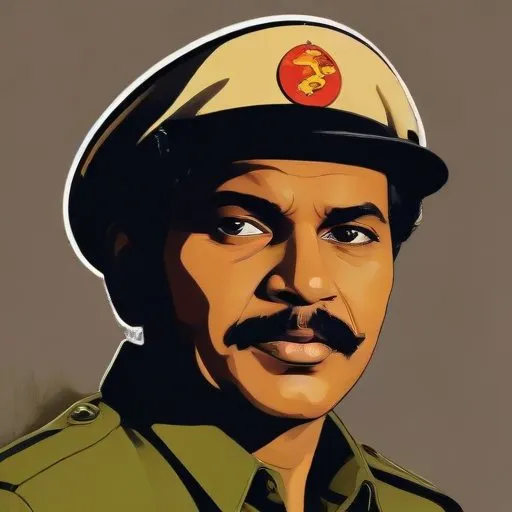
The founder of the Liberation Tigers of Tamil Eelam, a separatist organization that fought for an independent Tamil state in Sri Lanka, known for his militant leadership and guerrilla warfare tactics. He's infamous for his role in Sri Lanka's civil war and human rights abuses.
Velupillai Prabhakaran, the enigmatic founder and leader of the Liberation Tigers of Tamil Eelam (LTTE), is synonymous with Tamil nationalism and the quest for an independent Tamil state in Sri Lanka. For over two decades, he spearheaded a militant movement that sought to end the oppression of Tamils by the Sri Lankan government, earning him both admiration and notoriety worldwide.
Born on November 26, 1954, in Valvettithurai, a coastal town on Sri Lanka's Jaffna peninsula, Prabhakaran grew up in a region steeped in Tamil culture and literature. The youngest of four children, he was exposed to the growing discontent among Tamils, who faced discrimination and marginalization by the Sinhalese-dominated Sri Lankan government since the country's independence from the UK in 1948.
In 1976, Prabhakaran founded the LTTE, a militant organization that would become the vanguard of Tamil nationalism. The group's early years were marked by sporadic clashes with government forces, but it was the 1983 ambush of a Sri Lankan Army patrol outside Jaffna that catapulted the LTTE into the international spotlight. This incident, combined with the subsequent anti-Tamil pogrom, is widely regarded as the catalyst for the Sri Lankan Civil War.
After years of intense fighting, including the intervention of the Indian Army, the conflict was stalled in 2001 due to international mediation. By then, the LTTE had established a de facto state in the north and east of Sri Lanka, with Prabhakaran at its helm. This mini-state, complete with its own administrative structures, judiciary, and military, was a testament to the organization's resilience and Prabhakaran's unwavering leadership.
"I would prefer to die in honor rather than be caught alive." This quote, often attributed to Prabhakaran, reflects his unyielding commitment to the Tamil cause. While his determination inspired many, it also led to controversies and criticism. His leadership style, often described as authoritarian, was marked by iron-fisted control and a willingness to use violence to achieve his goals.
Prabhakaran's life and legacy are inextricably linked to the complex history of Sri Lanka's ethnic conflict. His movement, though maligned by some, remains a powerful symbol of Tamil resistance against perceived oppression. As the international community continues to grapple with the nuances of self-determination and national identity, Prabhakaran's story serves as a poignant reminder of the human cost of conflict and the enduring power of ethnic nationalism.
Prabhakaran's personal life remains shrouded in mystery, but it is known that he was married to Mathivathani Erambu, and they had a son, Charles Anthony. On May 18, 2009, Prabhakaran's life came to a tragic end, allegedly at the hands of the Sri Lankan military. His death marked the effective end of the LTTE as a militant force, but the ideals he championed continue to resonate with Tamils around the world.
80 Years Old
A Sri Lankan lawyer and politician who served as the 6th President of Sri Lanka, known for his role in ending the country's 26-year civil war. He's also infamous for alleged human rights abuses during his tenure.
81 Years Old
A pioneering female leader who served as Sri Lanka's first female President, known for her efforts to bring peace and reconciliation to the war-torn nation. She implemented policies to promote economic development and social welfare.
Born in 1899
A lawyer-turned-politician who championed Sinhalese nationalism and led Sri Lanka towards self-sufficiency, introducing sweeping reforms in education, agriculture, and industry. He's remembered for his bold, if sometimes divisive, leadership.
Born in 1916
The world's first female prime minister, who broke gender barriers in politics and led her country through a tumultuous period of economic and social change. She paved the way for future generations of female leaders.
