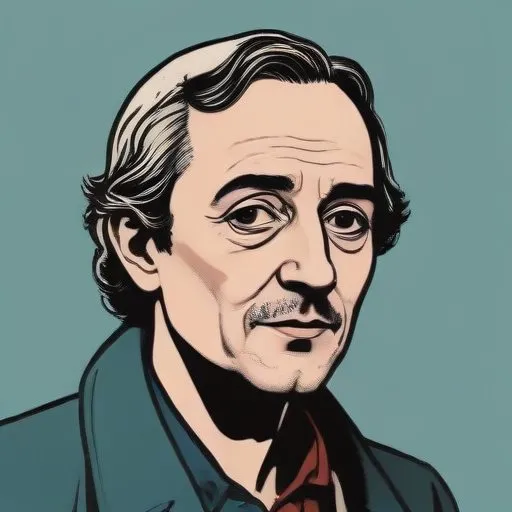
VICTOR DE LAPRADE: THE POETIC VOICE OF FRENCH PROVINCIAL LIFE
Early Life and Literary Beginnings
Victor de Laprade, born Pierre Martin Victor Richard de Laprade, on January 13, 1812, in Montbrison, Loire, France, was a celebrated French poet and critic, renowned for his poignant portrayal of French provincial life, its culture, piety, and sober patriotism. His literary career took off with the publication of his first collection of religious verses, "Les Parfums de Madeleine" in 1839, which was followed by "La colère de Jésus" in 1840, and "Psyche" in 1841.
A Literary Prophecy Fulfilled
In 1845, Laprade embarked on a literary research mission to Italy, which significantly influenced his writing style. Two years later, he was appointed professor of French literature at Lyon, a position that catapulted him to the forefront of French literary circles.
Académie Française and Controversy
In 1857, Laprade narrowly missed election to the Académie Française, losing by a single vote to Émile Augier. However, in 1858, he was elected to the prestigious institution, filling the seat vacated by Alfred de Musset.
Poetic Works and Themes
Laprade's poetry is characterized by its focus on French provincial life, with works such as "Pomes vangéliques" (1852), "Idylles héroïques" (1858), and "Les Voix du silence" (1864), which echo the sentiments of his contemporaries, Chateaubriand and
Alphonse de Lamartine. His poetry worships nature as a revelation of the divine, reflecting his deep sense of piety and patriotism.
Prose Works and Essays
In addition to his poetic works, Laprade penned several prose essays, including "Des habitudes intellectuelles de l'avocat" (1840), "Questions d'art et de morale" (1861), and "Le Sentiment de la nature, avant le Christianisme" (1866). These essays demonstrate his mastery of the French language and his philosophical insights into art, morality, and nature.
Political and Social Involvement
Laprade's literary talents were not limited to poetry and prose. He was an active participant in French politics, serving as a deputy in the National Assembly in 1871. During the Second Empire, he wrote a satirical poem, "Les Muses d'État," which led to his removal from his professorship at Lyon in 1861.
Legacy and Impact
Victor de Laprade's contributions to French literature are undeniable. His poetry and prose works continue to inspire generations of writers and scholars. A statue was erected in his memory at Montbrison, a testament to his enduring legacy.
Major Works
- Les Parfums de Madeleine (1839)
- La colère de Jésus (1840)
- Psyche (1841)
- Odes et poèmes (1844)
- Pomes vangéliques (1852)
- Idylles héroïques (1858)
- Les Voix du silence (1864)
- Pernette (1868)
- Pomes civiles (1873)
- Le Livre d'un père (1877)
- Varia and Livre des adieux (1878-1879)
Personal Milestones
- January 13, 1812: Born in Montbrison, Loire, France
- 1839: Published first collection of poems, Les Parfums de Madeleine
- 1845: Visited Italy on a literary research mission
- 1847: Appointed professor of French literature at Lyon
- 1857: Narrowly missed election to the Académie Française
- 1858: Elected to the Académie Française
- 1861: Removed from professorship at Lyon due to satirical poem, Les Muses d'État
- 1871: Elected to the National Assembly as a conservative deputy
- December 13, 1883: Passed away at the age of 71
FAQ
What was Victor de Laprades contribution to French poetry?
Victor de Laprade was a prominent French poet and critic who made significant contributions to the development of French poetry in the 19th century. He was known for his lyrical and introspective style, which explored themes of love, nature, and spirituality.
What was Victor de Laprades role in the French literary circle?
Victor de Laprade was part of a circle of French writers and intellectuals, including Charles Baudelaire, Gustave Flaubert, and Théodore de Banville, who shared his passion for literature and the arts.
What was Victor de Laprades stance on literary movements?
Victor de Laprade was a strong critic of the Romantic movement and advocated for a more classical approach to literature. He believed in the importance of form and structure in poetry, and opposed the excesses of Romanticism.
How did Victor de Laprades poetry reflect his personal experiences?
Victor de Laprades poetry reflected his personal experiences of love, loss, and spirituality. His poetry is characterized by its introspective and contemplative style, which explores the human experience.
What was Victor de Laprades legacy?
Victor de Laprades legacy is that of a respected poet and critic who contributed to the development of French literature in the 19th century. He remains an important figure in French literary history, and his poetry continues to be studied and admired today.