


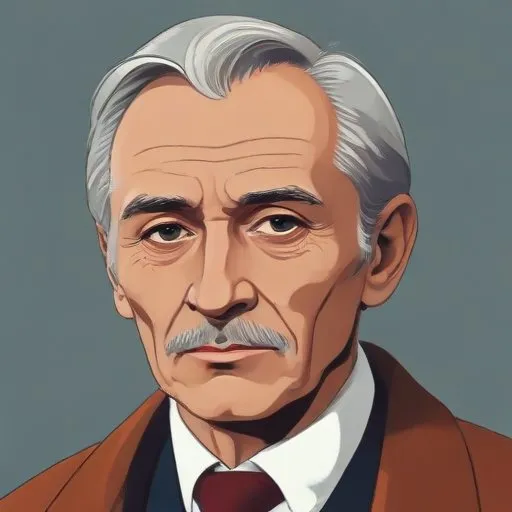
A Russian literary polymath, renowned for his versatile writings that spanned poetry, plays, and criticism, leaving an indelible mark on the country's cultural landscape.
Viktor Burenin, a Russian literary and theatre critic, publicist, novelist, dramatist, translator, and satirical poet, is notoriously known for his confrontational articles and satirical poems, mostly targeting leftist writers.
Born on March 6, 1841, in Moscow, Russian Empire, Burenin's literary career spanned several decades, during which he authored several popular plays, some co-authored with Alexey Suvorin, novels, and opera librettos, including Tchaikovsky's Mazepa and Cui's Angelo.
Burenin was born into a family of architect Pyotr Petrovich Burenin, as the twelfth child. During his student days at the Moscow College of Architecture (1852-1859), he befriended amnestied Decembrists, including Ivan Pushchin, Ivan Yakushkin, and Gavriil Batenkov, who introduced him to Russian literary circles.
A significant influence on Burenin's early career was Sergey Durov, a petrashevets who advised him to translate Barbier's Iambes et poèmes for the Geneva-based The Word of the Underground magazine.
In 1861, Burenin spent several months in Germany, Switzerland, and France, and his subsequent visits to Western Europe became a yearly affair. In the early 1860s, he became affiliated with the Russky Vestnik-centered literary society and attended Alexey Pleshcheev's Meetings, where he met prominent literary figures, including Lev Tolstoy, Mikhail Saltykov-Shchedrin, and Ivan Aksakov.
Burenin assisted Nikolai Nekrasov in gathering historical data on the Decembrist revolt for the latter's poem Russian Women. At the age of 20, he debuted with an article in Alexander Herzen's Kolokol, and in 1862, he started contributing satirical poems to magazines Iskra and Zritel, writing under the pseudonym Vladimir Monumentov.
In 1863, Burenin moved to Saint Petersburg and became a professional author a year later. His 1864 poem, July 13, 1864, about Chernyshevsky's trial, circulated widely, marking the beginning of a prolific literary career.
Burenin's satirical poetry and confrontational articles often targeted leftist writers, reflecting his conservative views and opposition to radical ideologies. His literary works also reflected his interest in Russian history and culture.
Burenin's literary career spanned a tumultuous period in Russian history, marked by the rise of radical movements and the decline of the Russian Empire. His works, while often provocative and critical, contributed to the literary landscape of the time, earning him recognition as a prominent literary figure.
Throughout his life, Burenin remained committed to his literary pursuits, leaving behind a legacy of provocative and thought-provoking works that continue to influence Russian literature to this day.
Born in 1828
A Russian literary giant who penned sweeping novels like "War and Peace" and "Anna Karenina", exploring the human condition with profound insight and masterful storytelling.
Born in 1821
A Russian literary mastermind who penned psychologically complex novels that probed the human condition, exploring themes of morality, philosophy, and the darker aspects of human nature.
Born in 1860
A renowned Russian literary mastermind, celebrated for crafting poignant, psychologically nuanced tales that probe the human condition, and pioneering the modern short story genre.
Born in 1899
A Russian-born novelist and critic, renowned for crafting intricate, lyrical prose and exploring themes of identity, morality, and the human condition through works like "Lolita" and "Pale Fire".
Born in 1890
A Russian literary giant, renowned for his poetic and novelistic masterpieces, including the epic "Doctor Zhivago", which captured the essence of Soviet Russia. His works are a testament to the power of literature in shaping cultural identity.
Born in 1880
A Russian literary giant, known for pioneering the avant-garde movement in literature, blending poetry and prose to create innovative, symbolic works that explored the human experience.
Born in 1818
A Russian literary mastermind who crafted poignant novels and plays that explored the human condition, delving into themes of love, family, and social change.
Born in 1891
A Russian literary mastermind, famous for blending fantasy and realism in works like "The Master and Margarita", which explores the intersection of politics, philosophy, and the human condition.
