


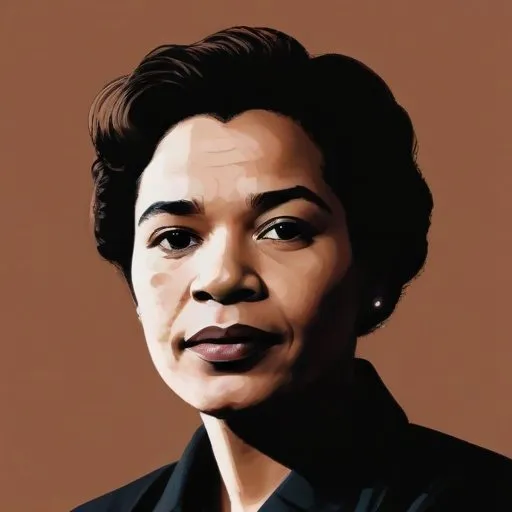
A pioneering civil rights activist who fought against racial segregation and discrimination, playing a key role in the Montgomery Bus Boycott and advocating for women's rights.
Virginia Foster Durr, a trailblazing American civil rights activist and lobbyist, left an indelible mark on the struggle for racial equality and social justice in the United States. Born on August 6, 1903, in Birmingham, Alabama, Durr's life was a testament to her unwavering commitment to fighting against discrimination and segregation.
Durr's journey towards becoming a civil rights activist began at Wellesley College in Massachusetts, where she enrolled in 1920. Her experience at Wellesley College was a turning point, as it was here that she began to question the racists attitudes and segregationist policies that had been instilled in her since childhood. The college's dining hall policy, which required students to eat with students of different races, forced Durr to confront her own biases and prejudices.
After withdrawing from Wellesley College due to financial reasons in 1923, Durr returned home to Birmingham, Alabama, where she met her future husband, Clifford Durr. The couple married in 1926 and had five children together. Throughout her life, Durr worked tirelessly to advance the cause of civil rights, lobbying for legislation to end segregation and discrimination.
Durr's circle of friends and acquaintances reads like a Who's Who of influential figures in the civil rights movement. She was close friends with Rosa Parks, the iconic civil rights activist who refused to give up her seat on a Montgomery bus, sparking the Montgomery Bus Boycott. Durr was also a confidante of Eleanor Roosevelt, and her sister's marriage to Supreme Court Justice Hugo Black made her a part of the justice's influential circle. Additionally, Durr was acquainted with Alger Hiss, a prominent figure in the State Department.
Durr's lobbying efforts played a significant role in the passage of landmark legislation, including the Civil Rights Act of 1957 and the 1964 Civil Rights Act. She was also an instrumental figure in the creation of the Southern Conference Educational Fund, a non-profit organization dedicated to promoting racial equality and social justice.
Durr's philosophy was rooted in her strong sense of social justice and her belief in the inherent worth and dignity of all individuals, regardless of race or background. Throughout her life, she advocated for a more inclusive and equitable society, where all people could live free from discrimination and oppression.
In 2006, Durr was posthumously inducted into the Alabama Women's Hall of Fame, a testament to her enduring legacy as a champion of civil rights and social justice.
Durr's life and work have had a profound impact on modern society, inspiring generations of activists and civil rights leaders. Her tireless advocacy for racial equality and social justice has helped to shape the course of American history, paving the way for a more inclusive and equitable society.
Virginia Foster Durr's life is a testament to the power of ordinary individuals to effect extraordinary change. Her legacy serves as a reminder of the ongoing struggle for civil rights and social justice, and the importance of continued activism and advocacy in the pursuit of a more just and equitable society.
As we reflect on Durr's remarkable life and achievements, we are reminded of the importance of standing up against discrimination and oppression, and of the transformative power of education and activism. Her story serves as a beacon of hope, inspiring us to continue the fight for social justice and human rights.
Born in 1886
A U.S. Supreme Court Justice who served for 34 years, known for his strong support of individual liberties and First Amendment rights.
Born in 1913
Refused to give up her seat on a Montgomery, Alabama bus to a white person, sparking the Montgomery Bus Boycott, a pivotal event in the Civil Rights Movement.
97 Years Old
A prominent leader in the civil rights movement, advocating for racial equality and social justice through nonviolent means, leaving a lasting impact on American history.
Born in 1899
A pioneering civil rights activist who organized the Montgomery Bus Boycott, sparking a wave of protests against racial segregation in the 1950s and 1960s.
Born in 1889
Leader of the Brotherhood of Sleeping Car Porters, pioneering the Civil Rights Movement through nonviolent protests and advocacy for African American workers' rights.
Born in 1912
A pioneering civil rights activist who played a key role in organizing the 1963 March on Washington, where Martin Luther King Jr. delivered his iconic "I Have a Dream" speech.
