


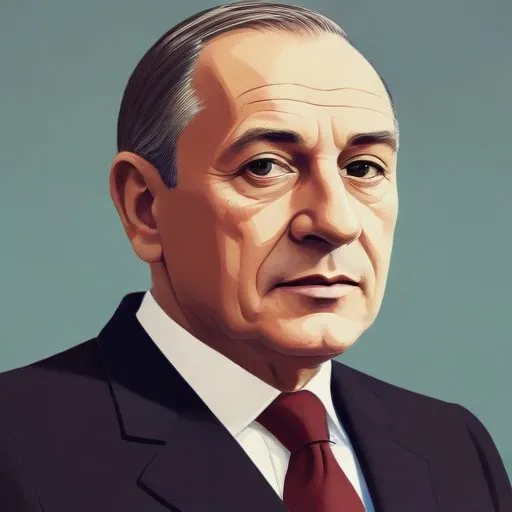
First Prime Minister of Slovakia, serving three non-consecutive terms, known for his role in the country's independence from Czechoslovakia.
Vladimr Meiar, a Slovak former politician, is best known for serving as the prime minister of Slovakia not once, not twice, but three times - from June 1990 to May 1991, June 1992 to March 1994, and again from December 1994 to October 1998. During his tenure, he oversaw the dissolution of Czechoslovakia in 1992-1993 and was a prominent figure in Slovak politics for over two decades.
Born on July 26, 1942, in Detva, Meiar was the eldest of four boys. His father was a tailor, and his mother was a housewife. Meiar's early career began in the Communist Party of Slovakia, where he became the committee chairman in the town of Ziar nad Hronom. However, his pro-reform speech to the national congress in 1969 led to his dismissal and subsequent expulsion from the Communist Party.
Undeterred, Meiar pursued his education, putting himself through the Faculty of Law of the Comenius University while working in a glass factory.
In late 1989, during the Velvet Revolution, Meiar joined the new political party, Public Against Violence (VPN), which was the Slovak counterpart to the Czech Civic Forum. His appointment as Minister of the Interior and Environment of Slovakia on January 11, 1990, marked the beginning of his rise to power.
Meiar's leadership style was criticized for being autocratic, with many accusing him of consolidating power and suppressing opposition. His connection to organized crime, known as Meiarism, further tarnished his reputation. Despite these controversies, Meiar remained a dominant figure in Slovak politics.
In 1999 and 2004, Meiar contested the presidential elections in Slovakia, but failed to secure the top spot. His populist party, Movement for a Democratic Slovakia (HZDS), remained a significant force in Slovak politics, however.
Meiar's legacy is marred by allegations of corruption, authoritarianism, and cronyism. His critics accuse him of undermining Slovakia's democratic institutions and fostering a culture of clientelism. Despite this, his supporters credit him with guiding Slovakia through a tumultuous period of transition and maintaining national unity.
Meiar has been married twice and has three children. Throughout his career, he has been driven by a strong sense of nationalism and a desire to assert Slovakia's independence.
| Year | Event |
|---|---|
| 1942 | Born in Detva, Slovakia |
| 1968 | Expelled from the Communist Party for pro-reform speech |
| 1990 | Appointed Minister of the Interior and Environment of Slovakia |
| 1992-1993 | Prime Minister of Slovakia during the dissolution of Czechoslovakia |
| 1999 | Contested presidential elections in Slovakia |
| 2004 | Contested presidential elections in Slovakia again |
As one of the most influential figures in modern Slovak politics, Vladimr Meiar's complex and often controversial legacy continues to shape the country's future. Love him or loathe him, Meiar's impact on Slovakia is undeniable, and his story serves as a reminder of the importance of accountability, transparency, and democratic values.
71 Years Old
Slovakia's Prime Minister from 1998 to 2006, known for leading the country's transition to a market economy and accession to the European Union and NATO.
Born in 1887
A Slovak priest-turned-politician who led Slovakia during World War II, implementing anti-Semitic laws and collaborating with the Nazis. He's infamous for his role in the Holocaust.
Born in 1921
A Slovak politician who led a brief, failed attempt to reform communism in Czechoslovakia during the Prague Spring of 1968, known for his efforts to introduce democratic reforms.
Born in 1913
Led the Communist Party of Czechoslovakia, implementing reforms and normalizing relations with the Soviet Union after the Prague Spring. Known for his role in shaping the country's post-war history.
89 Years Old
A Czech poet, playwright, and politician who led the country's transition from communism to democracy, and is known for his advocacy of human rights and individual freedom.
95 Years Old
The last leader of the Soviet Union, who introduced reforms that led to the end of the Cold War and the collapse of communism, earning a Nobel Peace Prize. He's known for his policies of glasnost and perestroika, which transformed the Soviet Union and the world.
