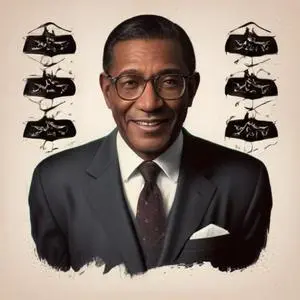
A Beacon of Liberty: The Unyielding Spirit of Walter E. Williams
Walter E. Williams, a stalwart advocate for individual liberty and limited government, left an indelible mark on the world of economics, politics, and academia. As a renowned economist, commentator, and author, Williams' unwavering commitment to classical liberal and libertarian principles inspired generations of thinkers and policymakers.
A Life of Purpose and Principle
Born on March 31, 1936, in Philadelphia, Pennsylvania, Williams' early life was marked by adversity and resilience. Growing up in the Richard Allen housing projects, he was raised by his mother and sister, with his father playing no role in his upbringing. Despite these challenges, Williams' innate curiosity and thirst for knowledge drove him to excel academically, earning a high school diploma from
Benjamin Franklin High School.
Williams' academic journey continued at Los Angeles City College, where he honed his skills in economics and politics. Following a brief stint as a cab driver, he was drafted into the United States Army in 1959. During his service, Williams refused to accept the racial segregation prevalent in the military, engaging in a one-man battle against Jim Crow. His courage in the face of adversity led to a court-martial proceeding, which he successfully argued and won, earning a reputation as a champion of justice.
A Career of Distinction
Williams' remarkable career spanned over five decades, during which he established himself as a leading authority on economics and public policy. He held the esteemed position of John M. Olin Distinguished Professor of Economics at
George Mason University, where he taught and inspired countless students. As a prolific author, Williams penned numerous books and articles, including
The State Against Blacks,
American Contempt for Liberty, and
Race and Economics: How Much Can Be Blamed on Discrimination?, which remain seminal works in the fields of economics and political science.
- Williams' syndicated columns, which appeared in publications such as Townhall, WND, and Jewish World Review, offered incisive commentary on economic and political issues, earning him a devoted readership across the United States.
- As a popular guest host on the Rush Limbaugh radio show, Williams brought his unique perspective and expertise to a broader audience, engaging in lively debates and discussions on current events.
- Through his writings and public appearances, Williams consistently advocated for individual freedom, limited government, and free market principles, inspiring a new generation of thinkers and policymakers.
Philosophical Contributions and Beliefs
Williams' intellectual contributions were deeply rooted in his commitment to classical liberal and libertarian principles. He believed that individual liberty and property rights were essential to human flourishing, and that government intervention in the economy often led to unintended consequences and social injustice.
Williams' philosophical stance was shaped by his experiences as an African American growing up in the segregated South, where he witnessed firsthand the corrosive effects of racism and government overreach. This personal understanding informed his work, as he sought to promote economic empowerment and social justice through free market solutions.
Legacy and Impact
Walter E. Williams' enduring legacy extends far beyond his impressive academic and professional achievements. As a champion of liberty and a beacon of hope, he inspired countless individuals to embrace the principles of individual freedom, limited government, and free market economics.
Through his tireless efforts, Williams has left an indelible mark on modern society, shaping public discourse and influencing policy debates. His unwavering commitment to principle and his willingness to challenge conventional wisdom have made him a beloved figure among libertarians and classical liberals worldwide.
A Final Tribute
As we reflect on the extraordinary life and achievements of Walter E. Williams, we are reminded of the power of individual initiative, intellectual curiosity, and moral courage. His unwavering dedication to the principles of liberty has inspired generations, and his legacy will continue to illuminate the path forward for those committed to promoting human freedom and prosperity.
Rest in peace, Walter E. Williams. Your spirit will continue to inspire and guide us, even as we strive to build a brighter future for all humanity.
FAQ
What is Walter E. Williams background in economics?
Walter E. Williams is a renowned American economist and academic who holds a doctorate in economics from the University of California, Los Angeles (UCLA). He is known for his work on public policy, economic history, and the economics of racism.
What is Walter E. Williams view on economic freedom?
Walter E. Williams is a strong advocate for economic freedom and limited government intervention in the economy. He believes that individuals should be free to pursue their own goals and aspirations without undue government interference.
What is Walter E. Williams take on racism and discrimination?
Walter E. Williams has written extensively on the economics of racism and discrimination. He argues that government policies often exacerbate racial disparities rather than alleviate them, and that true progress can only be achieved through individual freedom and entrepreneurship.
What is Walter E. Williams role at George Mason University?
Walter E. Williams was a distinguished professor of economics at George Mason University, where he taught for over three decades. He was also a member of the universitys Board of Visitors.
What are Walter E. Williams notable works?
Walter E. Williams has written several books, including The State Against Blacks and More Liberty Means Less Government. He has also written numerous articles and op-eds for publications such as The Wall Street Journal and Townhall.com.