


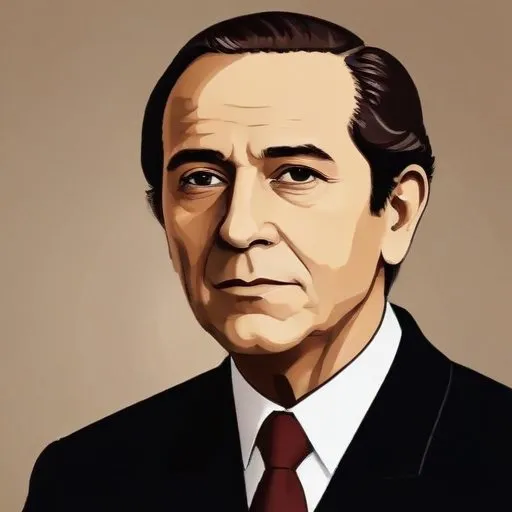
The 13th President of Brazil, a lawyer and politician who played a crucial role in shaping the country's constitution and economy during the 1920s. He's most known for his efforts to modernize and stabilize Brazil during a period of great turmoil.
Washington Lus Pereira de Sousa, also known as Washington Lus, was a Brazilian politician who served as the 13th president of Brazil from 1926 to 1930 and the last president of the First Brazilian Republic. He is known for his leadership during a tumultuous period in Brazilian history, marked by the Great Depression and the subsequent Brazilian Revolution of 1930.
Washington Lus was born on October 26, 1869, in Maca, Rio de Janeiro, Brazil, to a family of Portuguese Romani descent. He moved to São Paulo, where he pursued higher education and graduated from the University of São Paulo Law School in 1891.
Lus began his political career as an alderman in Batatais, São Paulo, and later became the President of the Municipal Chamber in 1897. He served as the mayor of Batatais from 1898 to 1899 and was elected congressman from the Farmers Party in 1900. He held various positions, including state representative for the Republican Party of São Paulo and Secretary of State of Justice and Public Safety, before being elected governor of São Paulo state in 1920.
Washington Lus was elected president of Brazil in 1926, marking the beginning of his presidency, which would be cut short by the Brazilian Revolution of 1930. During his presidency, he faced significant challenges, including the Great Depression, which had a devastating impact on the Brazilian economy. Despite his efforts to implement reforms and stabilize the economy, Lus lost the support of the military and was overthrown in a coup d'état on October 24, 1930. He was succeeded by the short-lived Brazilian Military Junta.
Washington Lus was known for his strong sense of justice and his commitment to education. He was a strong supporter of education reform and invested heavily in the development of schools and universities during his presidency. He was also a philanthropist, supporting various social causes and charities throughout his life.
One of Lus' most notable quotes is "O Brasil não é uma nação, é um continente" ("Brazil is not a nation, it's a continent"), highlighting the country's vast size and cultural diversity.
Washington Lus' presidency marked the end of the First Brazilian Republic, which had been in power since 1889. His overthrow and the subsequent establishment of the Brazilian Military Junta paved the way for the rise of Getúlio Vargas, who would dominate Brazilian politics for the next 15 years. Lus' legacy is complex, with some viewing him as a strong leader who fought to maintain democracy, while others see him as a symbol of the old oligarchic regime.
Born in 1882
A dominant leader who ruled Brazil from 1930 to 1945 and again from 1951 until his suicide in 1954, known for implementing reforms and promoting nationalism.
Born in 1917
A Brazilian lawyer and politician who served as the 22nd President of Brazil, known for his populist and nationalist policies, as well as his unexpected resignation after only seven months in office.
Born in 1918
A Brazilian lawyer and politician who served as the 24th President of Brazil, known for his left-wing policies and nationalization of industries, leading to a military coup that ousted him.
Born in 1907
Brazil's 29th President, a military leader who ruled with an iron fist, implementing economic reforms and gradually democratizing the country. He's remembered for his authoritarian yet modernizing governance.
Born in 1918
The 30th President of Brazil, a military leader who ruled from 1979 to 1985, is known for his role in transitioning the country from a military dictatorship to democracy. He implemented amnesty for political prisoners and allowed exiles to return.
