


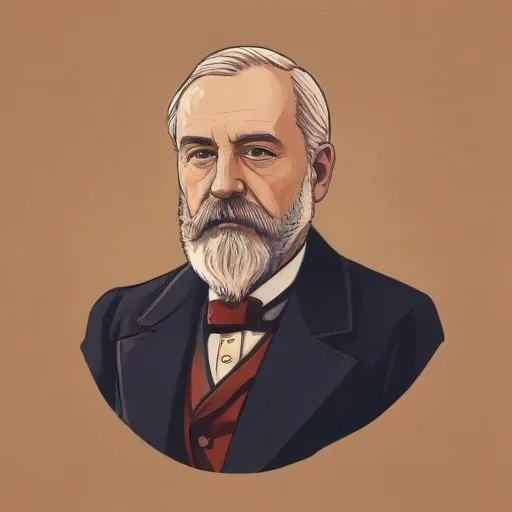
A German scholar who developed a philosophy of history and psychology, focusing on understanding human experiences and cultural systems through a holistic and empathetic approach. He's known for his work on hermeneutics, the theory of interpretation.
Wilhelm Dilthey, a German historian, psychologist, sociologist, and philosopher, is renowned for holding the esteemed G.W.F. Hegel's Chair in Philosophy at the University of Berlin. His groundbreaking work in the field of hermeneutics, the theory of interpretation, has left an indelible mark on modern philosophy.
Born on November 19, 1833, in Biebrich, Germany, Dilthey was the son of a Reformed pastor. He followed in his family's footsteps by studying theology at Heidelberg University, where he was influenced by prominent thinkers such as Kuno Fischer.
He later moved to the University of Berlin, where he was taught by esteemed scholars Friedrich Adolf Trendelenburg and August Boeckh, both former pupils of Friedrich Schleiermacher. Dilthey's academic prowess earned him a doctorate in 1864, with a thesis in Latin on Schleiermacher's ethics.
Dilthey's academic career was marked by significant milestones, including his appointment as a Privatdozent at Berlin in 1865 and his professorship at the University of Basel in 1867. He returned to Berlin in 1882, where he held the prestigious chair in philosophy at the university.
Dilthey's philosophical contributions were multifaceted, but his most notable work was in the field of hermeneutics. He believed that understanding human experiences and historical events required a nuanced approach, one that considered the complexities of individual perspectives and cultural contexts.
His work, particularly his magnum opus, "The Formation of the Historical World in the Human Sciences," laid the groundwork for modern hermeneutics, influencing thinkers such as Martin Heidegger and Hans-Georg Gadamer.
Dilthey's ideas have had a profound impact on various fields, including sociology, psychology, and literature. His emphasis on understanding human experiences and cultural contexts has shaped the way scholars approach social and historical research.
His influence extends beyond academia, with his work informing literary and cultural critiques, as well as inspiring new approaches to social science research.
Dilthey's legacy is a testament to the power of interdisciplinary thinking, demonstrating that philosophy can inform and enrich our understanding of the human experience.
In 1874, Dilthey married Katherine Puttmann, with whom he had one son and two daughters. His personal relationships and experiences deeply influenced his philosophical work, particularly his concepts of "life-experience" and "life-expression."
Dilthey's life was marked by a deep commitment to his work, but also by a sense of humility and introspection. His personal stories and anecdotes offer a glimpse into the life of a thinker who sought to understand the complexities of human existence.
Dilthey's words continue to inspire scholars and philosophers, encouraging them to explore the depths of human experience and understanding.
Dilthey's work must be considered within the context of 19th-century German philosophy, which was dominated by idealism. His empiricist approach, however, diverged significantly from the more positivist trends of British empiricism.
In comparison to his contemporaries, Dilthey's philosophical stance was unique, blending German literary and philosophical traditions with a commitment to understanding human experiences.
His work stands as a testament to the rich intellectual landscape of 19th-century Germany, a time of great philosophical ferment and innovation.
Born in 1724
Developed influential philosophical frameworks, such as the Critique of Pure Reason, that shaped modern Western thought on ethics, morality, and human understanding.
Born in 1770
A German philosopher and academic who developed a comprehensive and systematic philosophy that emphasized the unity of all things and the dialectical process of thesis, antithesis, and synthesis. His ideas have had a profound impact on modern thought, influencing fields such as philosophy, politics, and art.
Born in 1874
A philosopher who developed the concept of "symbolic forms" to understand human culture and knowledge, and is known for his work on the philosophy of science and the Enlightenment.
Born in 1889
A German philosopher and academic who explored the meaning of existence, time, and human existence, influencing 20th-century philosophy with his concept of "Being-in-the-world".
Born in 1859
A pioneer of phenomenology, this mathematician and philosopher developed a rigorous method to study conscious experience, seeking to understand how we perceive and interpret the world around us.
Born in 1864
Developed the concept of "social action" and is known for his theories on bureaucracy, capitalism, and the role of religion in shaping society.
Born in 1842
A founder of neo-Kantianism, this philosopher developed a comprehensive system of thought that integrated ethics, aesthetics, and religion, influencing 20th-century Jewish thought and philosophy.
