


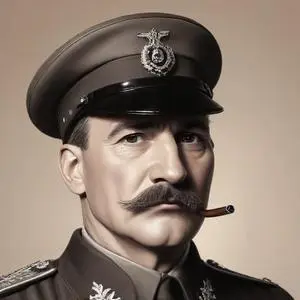
A German lawyer and politician who served as the Federal Minister of the Interior, implementing Nazi policies and laws that restricted civil liberties and paved the way for the Holocaust. He was a key figure in the Nazi regime's consolidation of power and persecution of Jews and other minorities.
Wilhelm Frick, a convicted war criminal and prominent German politician, served as the Minister of the Interior in Adolf Hitler's cabinet from 1933 to 1943, playing a crucial role in consolidating the Nazi regime. As the chief architect of the Interior Ministry, Frick was instrumental in formulating laws that defined the Nazi racial policy, including the notorious Nuremberg Laws.
Born on March 12, 1877, in the Palatinate municipality of Alsenz, Kingdom of Bavaria, Germany, Frick was the last of four children of Protestant teacher Wilhelm Frick senior. He attended the gymnasium in Kaiserslautern, passing his Abitur exams in 1896. Frick then studied philology at the University of Munich, but soon turned to study law.
Frick's involvement with the Nazi Party began in the early 1920s, and he took part in Hitler's failed Beer Hall Putsch of 1923, for which he was convicted of high treason. However, he managed to avoid imprisonment and soon became a leading figure of the Nazi Party in the Reichstag.
In 1933, after Hitler became Chancellor of Germany, Frick joined the new government as Minister of the Interior. In this role, he was responsible for overseeing the country's internal affairs, including law enforcement, education, and healthcare. Frick used his position to consolidate the Nazi regime, implementing policies that restricted individual freedoms and imposed harsh penalties on those deemed enemies of the state.
Frick's legislative contributions were instrumental in shaping the Nazi regime's policies. He played a key role in drafting laws that defined the Nazi racial policy, including:
As the war turned against Germany, Frick's influence began to wane. In 1943, he was replaced by Heinrich Himmler as interior minister, and he remained in the cabinet as a minister without portfolio until Hitler's death in 1945. Frick was tried and convicted of war crimes at the Nuremberg trials and executed by hanging on October 16, 1946.
Born in 1889
The dictator of Nazi Germany, responsible for the genocide of six million Jews and millions of other people during World War II, and infamous for his extreme nationalist and anti-Semitic ideology.
Born in 1893
A high-ranking Nazi official, he was a decorated World War I fighter pilot and later became a prominent politician, serving as Minister President of Prussia. He's infamous for his role in the Nazi regime and war crimes trials.
Born in 1897
A mastermind of Nazi propaganda, he crafted a persuasive narrative that fueled the Third Reich's rise to power, leaving a lasting impact on the world.
Born in 1900
Leading the SS and Gestapo, he oversaw the Nazi regime's brutal security apparatus and implemented the "Final Solution," orchestrating the genocide of six million Jews during World War II.
Born in 1894
A high-ranking Nazi official who flew to Scotland on a solo mission to negotiate peace with the UK, but was instead arrested and imprisoned.
Born in 1893
A German diplomat who served as the Nazi regime's Foreign Minister, orchestrating key alliances and treaties that led to World War II. He was a close associate of Adolf Hitler and played a crucial role in shaping Nazi foreign policy.
Born in 1903
Austrian-German lawyer and general who served as the highest-ranking leader of the Nazi police forces, responsible for overseeing the Gestapo, SS, and concentration camps during World War II. He was a key figure in the Holocaust and other atrocities committed by the Nazi regime.
Born in 1891
A German naval commander who led the U-boat fleet during World War II and briefly served as President of Germany after Hitler's death, known for his role in the war and its aftermath.
