


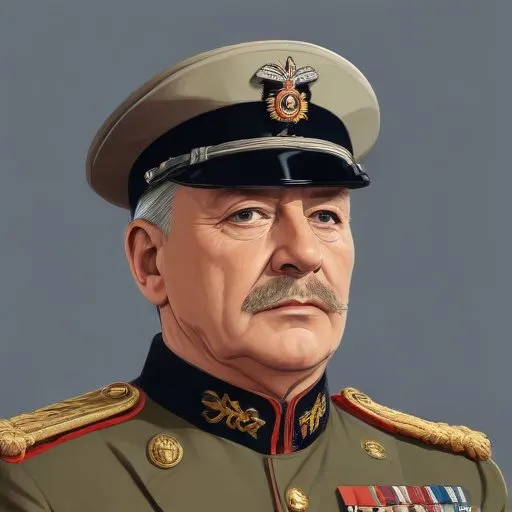
A prominent German field marshal who played a key role in the early successes of the German army during World War II, particularly in the invasion of France. He was a respected military strategist and commander.
Wilhelm Ritter von Leeb is best known for his role as a German Generalfeldmarschall (Field Marshal) of the Wehrmacht during World War II, where he commanded Army Group C during the Battle of France and Army Group North during Operation Barbarossa, the invasion of the Soviet Union. His military career was marked by both impressive tactical victories and disturbing allegations of war crimes and complicity in the Holocaust.
Born on September 5, 1876, in Landsberg am Lech, Wilhelm Josef Franz Leeb came from a Roman Catholic family. He joined the Bavarian Army in 1895 and served in China during the Boxer Rebellion. Between 1907 and 1913, he attended the Bavarian War Academy and served on the General Staff.
During World War I, Leeb rejoined the Bavarian Army and served on the Eastern Front, where he distinguished himself in various battles, including the Gorlice-Tarnów Offensive, the capture of the fortress Przemyśl, and the campaign in Serbia. In 1915, he was awarded the Military Order of Max Joseph, which granted him the title of nobility.
During World War II, Leeb commanded Army Group C, responsible for the breakthrough of the Maginot Line during the Battle of France. He later commanded Army Group North, which advanced through the Baltic States towards Leningrad (present-day St. Petersburg), eventually laying siege to the city. However, units under Leeb's command were accused of committing war crimes against the civilian population and closely cooperating with the SS Einsatzgruppen, death squads primarily tasked with the murder of the Jewish population as part of the Holocaust.
Following the war, Leeb was tried in the High Command Trial as part of the Subsequent Nuremberg Trials. He was convicted of transmitting the Barbarossa Decree and its criminal application by subordinate units and sentenced to three years' imprisonment, although he had already served the majority of his sentence by the time of his conviction.
Leeb was a beneficiary of Adolf Hitler's bribery scheme for senior Wehrmacht officers, receiving secret, extralegal gifts of 250,000 Reichsmark in 1941 and an estate valued at 638,000 Reichsmark in 1943. These financial benefits have been seen as an attempt to buy loyalty and silence from high-ranking military officials.
Wilhelm Ritter von Leeb's legacy is marked by controversy and moral ambiguity. While he was a skilled military strategist and commander, his involvement in war crimes and the Holocaust has tarnished his reputation. His conviction and trial served as a small measure of accountability for his actions, but the extent of his culpability remains a topic of debate among historians and scholars.
Born in 1889
The dictator of Nazi Germany, responsible for the genocide of six million Jews and millions of other people during World War II, and infamous for his extreme nationalist and anti-Semitic ideology.
Born in 1893
A high-ranking Nazi official, he was a decorated World War I fighter pilot and later became a prominent politician, serving as Minister President of Prussia. He's infamous for his role in the Nazi regime and war crimes trials.
Born in 1897
A mastermind of Nazi propaganda, he crafted a persuasive narrative that fueled the Third Reich's rise to power, leaving a lasting impact on the world.
Born in 1900
Leading the SS and Gestapo, he oversaw the Nazi regime's brutal security apparatus and implemented the "Final Solution," orchestrating the genocide of six million Jews during World War II.
Born in 1891
A renowned World War II military strategist, known for leading the Afrika Korps and earning the respect of both allies and enemies with his tactical genius.
Born in 1880
A German field marshal who led the Wehrmacht during World War II, playing a key role in the invasion of Poland and the Battle of Moscow. He was a prominent figure in the German high command during the war.
Born in 1876
A German naval leader who played a key role in the Kriegsmarine during World War II, overseeing the German U-boat fleet and naval operations. He was a close advisor to Adolf Hitler and implemented the German naval strategy during the war.
Born in 1891
A German naval commander who led the U-boat fleet during World War II and briefly served as President of Germany after Hitler's death, known for his role in the war and its aftermath.
