


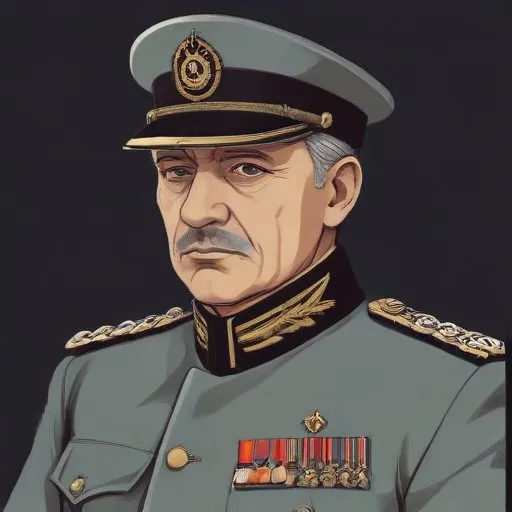
A German field marshal who led the Wehrmacht during World War II, playing a key role in the invasion of Poland and the Battle of Moscow. He was a prominent figure in the German high command during the war.
Fedor von Bock, a German Generalfeldmarschall, is remembered for his crucial role in the Second World War, particularly as the commander of Army Group Center during the invasion of the Soviet Union in 1941. His military career was marked by both triumph and tragedy, as he played a key role in the Nazi war machine, only to meet a sudden and untimely demise.
Born on December 3, 1880, in Küstrin, Germany (now Kostrzyn, Poland), Fedor von Bock came from a long line of Prussian military officers. His father, Moritz Albert Karl von Bock, had commanded a division during the Franco-Prussian War of 1870-1871, and his mother, Olga Helene Franziska von Falkenhayn, was the sister of Erich von Falkenhayn, Chief of the German General Staff during World War I.
At the age of eight, Bock enrolled in a military academy in Berlin, where he received an education steeped in Prussian militarism. He quickly proved himself to be an adept student, laying the foundation for his future military career.
During World War I, Bock served as a junior officer on the Western Front, where he was wounded twice and awarded the Iron Cross for his bravery. After the war, he remained in the Reichswehr, slowly rising through the ranks to become a major general by 1931.
With the Nazi rise to power, Bock's career accelerated, and he became a trusted commander of the German Army. He played a key role in the invasion of Poland in 1939, leading Army Group North to victory, and subsequently commanded Army Group B during the invasion of France in 1940.
In June 1941, Bock was appointed commander of Army Group Center, tasked with leading the invasion of the Soviet Union. His forces made rapid gains, capturing Minsk, Smolensk, and Vyazma, and pushing deep into Soviet territory.
However, the German advance was slowed by the punishing Soviet winter, and Bock's forces were eventually halted at the gates of Moscow. The Soviet counteroffensive, which began in December 1941, drove the German army back, and Bock was relieved of his command by Adolf Hitler in December 1942.
Bock was a monarchist who maintained a certain distance from politics, yet he remained loyal to the Nazi regime. He was known for his outspokenness, a trait that earned him a degree of tolerance from Hitler.
In his personal life, Bock was married twice, first to Marga von Reichenbach, who died in 1938, and then to Ursula von Luettichau, whom he married in 1940. He also had a stepdaughter, Baroness Wilhelmine von Oertzen.
Fedor von Bock's life came to an abrupt end on May 4, 1945, when he was killed, along with his second wife and stepdaughter, by a strafing Royal New Zealand Air Force fighter-bomber as they traveled by car towards Hamburg.
Bock's military career was marked by both conquest and defeat, reflective of the turbulent era in which he lived. While he played a significant role in the Nazi war effort, his legacy is also shrouded by the atrocities committed by the regime.
In the aftermath of World War II, Bock's name became synonymous with the failed German invasion of the Soviet Union, and his reputation was forever tied to the ill-fated Operation Typhoon.
Despite his controversial legacy, Fedor von Bock remains an important figure in the annals of military history, a testament to the complex and often conflicting nature of human ambition and duty.
Born in 1891
A renowned World War II military strategist, known for leading the Afrika Korps and earning the respect of both allies and enemies with his tactical genius.
Born in 1888
A pioneering tank commander who revolutionized modern warfare with his innovative blitzkrieg tactics, earning him the nickname "Father of the Panzerwaffe".
Born in 1887
A highly decorated military strategist who played a crucial role in several key battles during World War II, including the invasion of France and the Siege of Leningrad.
Born in 1882
A high-ranking military officer who played a crucial role in World War II, particularly in the Battle of France and the plot to assassinate Adolf Hitler.
Born in 1891
A skilled and highly decorated military leader, known for his tactical genius and defensive strategies during World War II, earning him the respect of both his allies and enemies.
Born in 1893
A high-ranking Nazi official, he was a decorated World War I fighter pilot and later became a prominent politician, serving as Minister President of Prussia. He's infamous for his role in the Nazi regime and war crimes trials.
Born in 1897
A mastermind of Nazi propaganda, he crafted a persuasive narrative that fueled the Third Reich's rise to power, leaving a lasting impact on the world.
Born in 1893
A German diplomat who served as the Nazi regime's Foreign Minister, orchestrating key alliances and treaties that led to World War II. He was a close associate of Adolf Hitler and played a crucial role in shaping Nazi foreign policy.
