


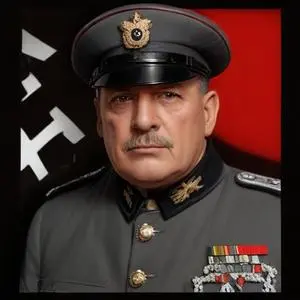
A highly decorated military strategist who played a crucial role in several key battles during World War II, including the invasion of France and the Siege of Leningrad.
Erich von Manstein, a German Generalfeldmarschall, is best known for his innovative military strategy, the Sichelschnitt, which played a crucial role in the German army's rapid advance through France and the Low Countries during World War II. His bold and unconventional plan, which involved a surprise attack through the Ardennes forest, caught the Allies off guard and led to a decisive German victory.
Born on November 24, 1887, in Berlin, Germany, Erich von Manstein was born into an aristocratic Prussian family with a long history of military service. He joined the army at a young age and saw service on both the Western and Eastern Fronts during World War I, rising to the rank of captain by the end of the war.
In the interwar period, Manstein played an active role in helping Germany rebuild its armed forces. In 1939, he served as Chief of Staff to Gerd von Rundstedt's Army Group South during the invasion of Poland, which marked the beginning of World War II.
In 1940, Manstein devised an innovative operation to invade France, later known as the Sichelschnitt or the "sickle cut." This plan called for an attack through the woods of the Ardennes and a rapid drive to the English Channel, thus cutting off the French and Allied armies in Belgium and Flanders.
Manstein's plan was initially met with skepticism by his superiors, but Adolf Hitler eventually chose it as the basis for the German invasion of France. The plan's success was unprecedented, with German forces advancing rapidly through France and the Low Countries, leading to a decisive German victory.
Manstein's success in France led to his promotion to general, and he went on to play a key role in several major military campaigns, including the invasion of the Soviet Union and the siege of Sevastopol. He was promoted to field marshal on July 1, 1942, after which he participated in the siege of Leningrad.
In December 1942, during the catastrophic Battle of Stalingrad, Manstein commanded a failed relief effort, Operation Winter Storm. However, he later led a successful counteroffensive in the Third Battle of Kharkov, regaining substantial territory and earning him recognition as one of Germany's most skilled military commanders.
After Germany's defeat in World War II, Manstein was arrested and charged with war crimes. He was convicted and sentenced to 18 years imprisonment, but was released in 1953 due to ill health.
Manstein spent the remainder of his life writing his memoirs, which were published in 1958. He died on June 9, 1973, at the age of 85.
Erich von Manstein's military career was marked by innovation and boldness, and his plan for the invasion of France remains one of the most significant military achievements of World War II. While his legacy is also marked by controversy and criticism, there is no doubt that he was a skilled and influential military commander who played a significant role in shaping the course of World War II.
In conclusion, Erich von Manstein was a complex and multifaceted figure, whose military achievements continue to be studied and debated by historians and military strategists today. While his legacy is marked by controversy, there is no doubt that he was a skilled and influential military commander who played a significant role in shaping the course of World War II.
Born in 1889
The dictator of Nazi Germany, responsible for the genocide of six million Jews and millions of other people during World War II, and infamous for his extreme nationalist and anti-Semitic ideology.
Born in 1900
Leading the SS and Gestapo, he oversaw the Nazi regime's brutal security apparatus and implemented the "Final Solution," orchestrating the genocide of six million Jews during World War II.
Born in 1893
A high-ranking Nazi official, he was a decorated World War I fighter pilot and later became a prominent politician, serving as Minister President of Prussia. He's infamous for his role in the Nazi regime and war crimes trials.
Born in 1897
A mastermind of Nazi propaganda, he crafted a persuasive narrative that fueled the Third Reich's rise to power, leaving a lasting impact on the world.
Born in 1891
A German naval commander who led the U-boat fleet during World War II and briefly served as President of Germany after Hitler's death, known for his role in the war and its aftermath.
Born in 1880
A German field marshal who led the Wehrmacht during World War II, playing a key role in the invasion of Poland and the Battle of Moscow. He was a prominent figure in the German high command during the war.
Born in 1888
A pioneering tank commander who revolutionized modern warfare with his innovative blitzkrieg tactics, earning him the nickname "Father of the Panzerwaffe".
Born in 1882
A high-ranking Nazi officer who served as the Chief of the OKW, the German High Command, during World War II, and was known for his unwavering loyalty to Hitler. He was tried and executed for war crimes after the war.
