


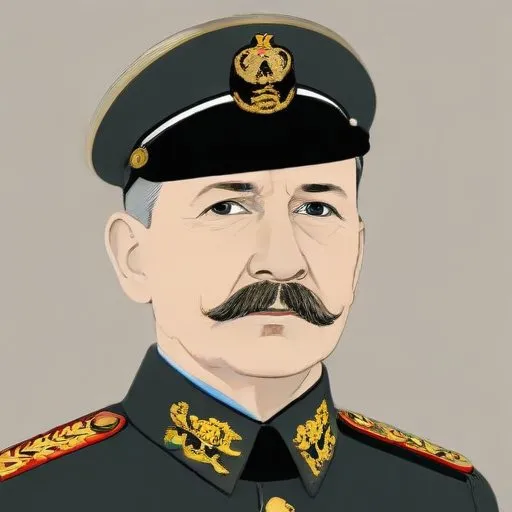
A high-ranking military officer who played a crucial role in World War II, particularly in the Battle of France and the plot to assassinate Adolf Hitler.
Known for his strategic command on both the Eastern and Western Fronts during World War II, Gnther von Kluge was a German Generalfeldmarschall who played a crucial role in several key battles, including the invasion of Poland, the Battle of France, and the Battle for Moscow.
Born on October 30, 1882, in Posen, Prussia (now western Poland), Gnther von Kluge came from an aristocratic Prussian military family. His father, Max von Kluge, was a distinguished commander and lieutenant general in the German Army who served in World War I. Gnther's mother, Elise KhnSchuhmann, married Max in 1881, and Gnther was one of their two children.
Kluge's military career began in 1901, and he quickly rose through the ranks, earning recognition for his bravery and strategic thinking. During World War I, he served as a staff officer and later commanded an infantry battalion. After the war, he remained in the Reichswehr, the German army, and continued to advance in rank.
In 1939, Kluge commanded the 4th Army during the invasion of Poland, and in 1940, he led the army during the Battle of France, earning a promotion to Generalfeldmarschall. He went on to command the 4th Army in Operation Barbarossa, the invasion of the Soviet Union, and the Battle for Moscow in 1941.
In December 1941, Kluge was promoted to command Army Group Centre, replacing Field Marshal Fedor von Bock, amid the crisis of the Soviet counteroffensive. Several members of the German military resistance to Adolf Hitler served on his staff, including Henning von Tresckow. Although Kluge was aware of the plotters' activities, he refused to offer his support unless Hitler was killed.
Kluge's command on the Eastern Front lasted until October 1943, when he was badly injured in a car accident. Following a lengthy recuperation, he was appointed OB West, Supreme Commander West, in occupied France in July 1944, after his predecessor, Field Marshal Gerd von Rundstedt, was dismissed for defeatism.
Kluge's forces were unable to stop the momentum of the Allied invasion of Normandy, and he began to realize that the war in the West was lost. Although Kluge was not an active conspirator in the 20 July plot, in the aftermath of the failed coup, he committed suicide on August 19, 1944, after being recalled to Berlin for a meeting with Hitler.
Kluge's military career was marked by his tactical genius and bravery, but also by his complex and often conflicted relationships with his fellow officers and Hitler. His legacy is still debated among historians, with some viewing him as a skilled commander who was ultimately caught up in the chaos of war, while others see him as a flawed and complicit participant in the Nazi regime.
Despite his controversial legacy, Gnther von Kluge remains an important figure in the history of World War II, and his story serves as a reminder of the complexities and moral ambiguities of war.
Born in 1889
The dictator of Nazi Germany, responsible for the genocide of six million Jews and millions of other people during World War II, and infamous for his extreme nationalist and anti-Semitic ideology.
Born in 1900
Leading the SS and Gestapo, he oversaw the Nazi regime's brutal security apparatus and implemented the "Final Solution," orchestrating the genocide of six million Jews during World War II.
Born in 1893
A high-ranking Nazi official, he was a decorated World War I fighter pilot and later became a prominent politician, serving as Minister President of Prussia. He's infamous for his role in the Nazi regime and war crimes trials.
Born in 1891
A renowned World War II military strategist, known for leading the Afrika Korps and earning the respect of both allies and enemies with his tactical genius.
Born in 1880
A German field marshal who led the Wehrmacht during World War II, playing a key role in the invasion of Poland and the Battle of Moscow. He was a prominent figure in the German high command during the war.
Born in 1882
A high-ranking Nazi officer who served as the Chief of the OKW, the German High Command, during World War II, and was known for his unwavering loyalty to Hitler. He was tried and executed for war crimes after the war.
Born in 1881
A German field marshal who played a crucial role in the Nazi war effort, serving as the commander-in-chief of the German Army from 1938 to 1941. He was a key figure in the invasion of Poland and the Battle of France.
Born in 1876
A German naval leader who played a key role in the Kriegsmarine during World War II, overseeing the German U-boat fleet and naval operations. He was a close advisor to Adolf Hitler and implemented the German naval strategy during the war.
