


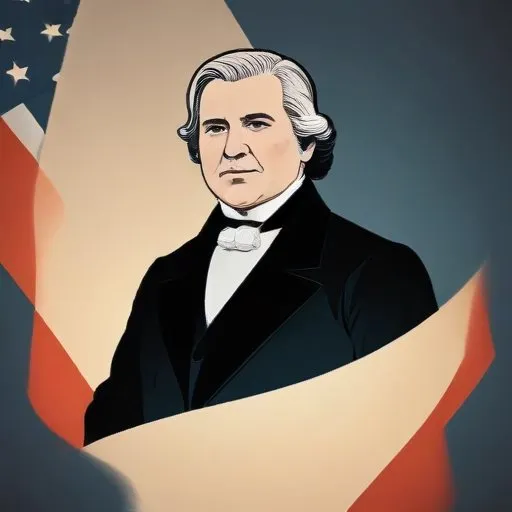
A signer of the US Constitution and one of the first senators from Tennessee, known for his role in the state's early development and a scandalous land speculation scheme.
William Blount, a prominent figure in American history, is best known for his instrumental role in shaping the United States' expansion and development. As a Founding Father, he signed the Constitution of the United States and played a crucial part in Tennessee's admission to the Union.
Born on April 6, 1749, in Windsor, Province of North Carolina, Blount came from a prominent family. He served as a paymaster during the American Revolutionary War and later became a member of the North Carolina legislature in 1781. Throughout the decade, he held various roles in the legislature, except for two terms in the Continental Congress in 1782 and 1786.
In 1787, Blount attended the Constitutional Convention as a member of the North Carolina delegation. Two years later, he led the efforts for North Carolina to ratify the Constitution at the Fayetteville Convention. His leadership paved the way for Tennessee's statehood, and he became the only governor of the Southwest Territory in 1790.
During his tenure as governor, Blount negotiated the Treaty of Holston in 1791, which brought thousands of acres of Indian lands under U.S. control. He also played a key role in helping Tennessee gain admission to the Union as the 16th state in 1796.
Blount was a shrewd land speculator, gradually acquiring millions of acres in Tennessee and the Trans-Appalachian West. However, his risky investments left him in debt. In the 1790s, he conspired to have Great Britain take over Spanish-controlled Louisiana and Florida, hoping to boost local land prices. When the conspiracy was uncovered in 1797, he was expelled from the Senate and became the first federal official to face impeachment.
Despite the controversy, Blount remained popular in Tennessee and served in the state senate during the last years of his life. He died on March 21, 1800, leaving behind a complex legacy as a statesman, land speculator, and Founding Father.
William Blount's contributions to the United States' expansion and development continue to shape the country's identity. His legacy serves as a reminder of the complexities of American history, where visionary leaders and land speculators often walked a fine line between progress and controversy.
Born in 1751
The 4th President of the United States, often referred to as the "Father of the Constitution," played a crucial role in drafting the US Constitution and Bill of Rights, shaping the country's government and laws. He was a strong advocate for individual liberties and limited government power.
Born in 1758
The 5th President of the United States was a skilled military leader and statesman who oversaw the acquisition of Florida from Spain and issued the Monroe Doctrine, a policy of opposing European colonization in the Americas. He is also known for being the last of the Founding Fathers to hold the presidency.
Born in 1743
The principal author of the Declaration of Independence and a strong advocate for individual liberties and limited government, shaping America's foundational principles. He oversaw the Louisiana Purchase, doubling the country's territory.
Born in 1767
A fiery leader who expanded democracy and shaped the country's economy, known for his populist policies and controversial decisions, including the forced relocation of Native Americans.
Born in 1767
The 6th President of the United States was a skilled diplomat and leader who played a key role in shaping America's foreign policy and expansion. He's also known for being the son of a president and a president himself, making him part of a unique American political dynasty.
Born in 1777
A skilled orator and compromiser who played a crucial role in shaping the country's early development, particularly through his "American System" economic plan. He's also known for his numerous presidential bids and influential leadership in the Senate.
Born in 1782
A renowned lawyer and politician who served as the 14th United States Secretary of State, known for his exceptional oratory skills and influential role in shaping the country's early development.
Born in 1782
A prominent figure in American politics, serving as Vice President and advocating for states' rights, particularly in regards to slavery. He played a significant role in shaping the country's early development.
