


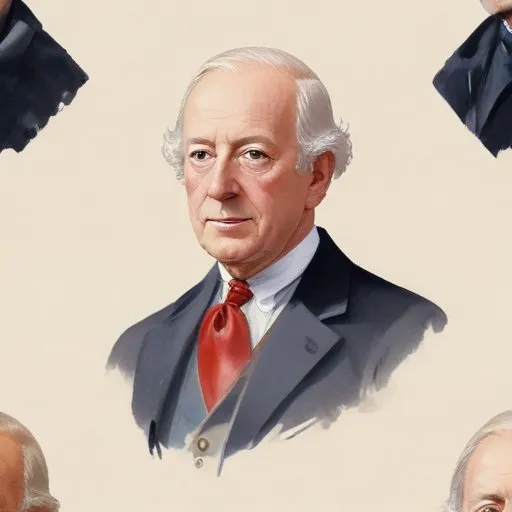
A British aristocrat who served as Prime Minister from 1756 to 1757, known for his brief tenure and lack of significant accomplishments. He was a prominent figure in 18th-century British politics, but his impact was limited.
William Cavendish, 4th Duke of Devonshire, was a British Whig statesman and nobleman who briefly served as the nominal Prime Minister of Great Britain. He is perhaps better known for his influential role in British politics during the mid-18th century, serving as Lord Lieutenant of Ireland and Master of the Horse, among other notable positions.
Born on May 8, 1720, to William Cavendish, 3rd Duke of Devonshire, and his wife, Catherine Hoskins, William was the eldest of four sons. He was baptized at St Martins-in-the-Fields in London and possibly educated privately at home before embarking on a grand tour of France and Italy in 1739-40, accompanied by his tutor.
Elected as Member of Parliament (MP) for Derbyshire in 1741 and 1747, Devonshire was a supporter of Sir Robert Walpole and later of the Pelhams. His allegiance to the Pelham faction earned him the description of being "as errant a bigot" by Horace Walpole. In 1747, he was appointed Master of the Horse, a position he held until 1755, necessitating his departure from the House of Commons for the House of Lords by writ of acceleration as Baron Cavendish.
In April 1755, Devonshire became Lord Lieutenant of Ireland, serving until January 1757, and was one of the Lords Justices of the realm during the King's absence in Hanover. Following his father's death in December 1755, he succeeded as Duke of Devonshire.
Through his descendants, Devonshire is an ancestor of King Charles III, making him a great-great-great-great-great-grandfather of the monarch. His brief but eventful life left an indelible mark on British politics and society during the mid-18th century.
Despite being known for his strong political allegiances, there are no recorded quotes or sayings attributed to William Cavendish, 4th Duke of Devonshire.
Devonshire's significant contributions to British politics earned him a place in the Privy Council and the title of Duke of Devonshire, solidifying his legacy as a prominent statesman of his time.
In comparison to his contemporaries, Devonshire's rise to prominence was marked by his unwavering loyalty to the Pelham faction, which set him apart from other politicians of his era. His brief tenure as Prime Minister further distinguishes him from his contemporaries, who often held the position for longer periods.
Despite his relatively short life, William Cavendish, 4th Duke of Devonshire, left an indelible mark on British politics and society, cementing his place in history as a notable statesman and nobleman of the 18th century.
Born in 1759
Prime Minister of the United Kingdom from 1783 to 1801 and 1804 to 1806, known for leading the country through the French Revolutionary and Napoleonic Wars.
Born in 1749
A prominent 18th-century politician who championed individual liberties and opposed British imperialism, known for his charismatic oratory skills and influential foreign policy decisions.
Born in 1738
The British monarch who ruled during the American Revolution, losing the colonies, and later suffered a mental illness that led to a regency crisis. He's also known for his cultural and artistic patronage.
Born in 1762
The extravagant and flamboyant King of the United Kingdom, known for his lavish lifestyle, extravagant fashion sense, and architectural projects, including the transformation of Buckingham Palace. He played a significant role in the development of Regency London.
Born in 1759
An 18th-century academic and politician who served as Prime Minister of the United Kingdom, known for his role in abolishing the slave trade in the British Empire.
Born in 1762
The only British Prime Minister to be assassinated, he served from 1809 to 1812 and is known for his strong leadership during the Napoleonic Wars.
Born in 1770
A skilled lawyer and politician who served as Prime Minister of the United Kingdom, known for his strong oratory skills and brief but influential tenure in office.
