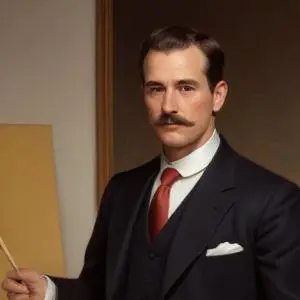
William Merritt Chase: The Pioneering American Painter
Impressionist Mastermind and Art Educator
William Merritt Chase was a renowned American painter, celebrated as a prominent exponent of Impressionism and a devoted art educator. He is particularly recognized for establishing the Chase School, which later evolved into the esteemed Parsons School of Design.
Early Life and Training
Born on November 1, 1849, in Williamsburg (now Nineveh), Indiana, Chase was the son of Sarah Swain and David H. Chase, a local businessman. His early life was marked by a passion for art, which was encouraged by his family. Chase received his initial training under local self-taught artists Barton S. Hays and Jacob Cox.
The Turning Point: New York and Europe
At the age of 19, Chase embarked on a brief stint as a sailor, traveling to Annapolis and later commissioning a merchant ship. However, he soon realized that the Navy was not his calling and redirected his focus towards art. Chase's teachers urged him to pursue his artistic ambitions in New York, where he enrolled in the National Academy of Design under Lemuel Wilmarth, a student of the famous French artist Jean-Léon Gérôme.
In 1870, Chase's family faced financial difficulties, prompting him to relocate to St. Louis, Missouri. During this period, he became an active member of the local art community, winning prizes for his paintings and exhibiting his work at the National Academy in 1871. His talent caught the attention of wealthy St. Louis collectors, who sponsored his two-year trip to Europe in exchange for paintings and his assistance in acquiring European art for their collections.
European Sojourn and Artistic Development
Chase settled at the Academy of Fine Arts in Munich, a hub of art training that attracted numerous American artists. Under the guidance of Alexander von Wagner, he honed his skills and developed his unique style, which blended traditional techniques with Impressionist principles.
Career Highlights and Major Works
Upon his return to the United States, Chase's artistic career flourished. He established the Chase School, which later became the Parsons School of Design, and taught many notable students, including
Charles Demuth,
Edward Hopper, and
Georgia O'Keeffe. Some of his notable works include:
- The Tenth Street Studio (1880) – a masterpiece showcasing his New York studio
- The Nursery (1881) – a captivating portrait of his daughter, Alice
- The Fairy Tale (1896) – a whimsical and enchanting work exemplifying his Impressionist style
Philosophical Contributions and Beliefs
Chase was a strong advocate for the importance of artistic training and the development of individual style. He believed that art should be rooted in observation and inspired by the beauty of the natural world.
Legacy and Impact on Modern Society
William Merritt Chase's contributions to American art are immeasurable. As a pioneering figure in Impressionism, he paved the way for future generations of artists. His dedication to art education instilled a sense of innovation and creativity in his students, many of whom went on to become influential artists in their own right.
Personal Milestones and Key Life Events
- 1878: Married Alice Gerson, with whom he had eight children
- 1893: Became a member of the National Academy of Design
- 1916: Passed away on October 25, leaving behind a legacy of artistic excellence and educational leadership
Chase's remarkable life and career continue to inspire artists, educators, and art enthusiasts alike. His commitment to his craft and his passion for sharing his knowledge have left an indelible mark on the world of art.
FAQ
What was William Merritt Chases style and technique in painting?
William Merritt Chase was an American painter known for his Impressionist and plein-air style, which emphasized the capture of light and color in outdoor settings. He was particularly skilled in painting landscapes, seascapes, and still lifes.
What were William Merritt Chases most famous paintings?
William Merritt Chases most famous paintings include Hide and Seek (1888), The Tenth Street Studio (1880), and The Lone Fisherman (1895). These works showcase his skill in capturing the beauty and complexity of light and color.
How did William Merritt Chases work influence the development of American Impressionism?
William Merritt Chases work was instrumental in the development of American Impressionism, a movement that emphasized the capture of light and color in outdoor settings. His paintings influenced a generation of American artists, including Mary Cassatt and John Singer Sargent.
What was William Merritt Chases contribution to art education?
William Merritt Chase was a dedicated art educator who taught at the Art Students League of New York and the Pennsylvania Academy of the Fine Arts. He helped to shape the development of American art education and was a mentor to many prominent artists.
How is William Merritt Chase remembered today?
William Merritt Chase is remembered as a pioneering figure in American Impressionism, whose work helped to shape the development of the movement. His paintings continue to be celebrated for their beauty, skill, and emotional power.