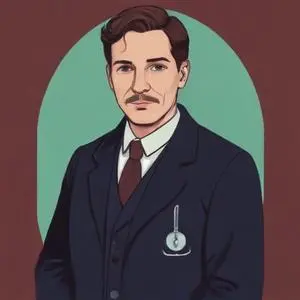
William Stewart Halsted: The Pioneering Surgeon Who Revolutionized Modern Surgery
A Champion of Aseptic Technique and Anesthesia
William Stewart Halsted was an American surgeon who left an indelible mark on the field of medicine. He is renowned for his relentless emphasis on strict aseptic technique during surgical procedures, his early advocacy for the use of newly discovered anesthetics, and his introduction of several innovative operations, including the radical mastectomy for breast cancer.
The "Big Four" of Johns Hopkins Hospital
Halsted was one of the founding professors at the prestigious
Johns Hopkins Hospital, along with
William Osler, Howard Atwood Kelly, and William H. Welch. This group of distinguished medical professionals is often referred to as the "Big Four" of Johns Hopkins Hospital. His operating room at the hospital, located in Ward G, was a hub of medical innovation and discovery, where Halsted performed countless surgeries with remarkable precision and skill.
A Trailblazer in Surgery
Throughout his illustrious career, Halsted introduced numerous novel surgical procedures, including the first successful thyroidectomy, the first radical mastectomy for breast cancer, and the development of modern surgical techniques for hernia repair. His pioneering work in surgery earned him international recognition and admiration from his peers.
Personal Life and Struggles
Despite his professional triumphs, Halsted struggled with personal demons. He was addicted to cocaine and later morphine, which were not illegal during his time. His addiction was a result of experiments on the use of cocaine as an anesthetic agent that he performed on himself. According to William Osler's diary, Halsted developed a high level of drug tolerance for morphine, eventually requiring a daily dose of three grains (approximately 200 mg).
Early Life and Family
William S. Halsted was born on September 23, 1852, in New York City, to Mary Louisa Haines and William Mills Halsted, Jr. His family was of English heritage and possessed significant wealth, with two homes in the state of New York. Halsted's father was a successful businessman and active member of the community. Although raised a Presbyterian, Halsted became an agnostic in adulthood.
Legacy and Impact
Halsted's contributions to modern surgery have had a profound impact on the medical community. His emphasis on aseptic technique and anesthesia revolutionized surgical procedures, significantly reducing the risk of infection and mortality. His work paved the way for future generations of surgeons and ultimately transformed the field of medicine.
Timeline of Key Events
- 1852: Born on September 23rd in New York City
- 1874: Graduated from Columbia University College of Physicians and Surgeons
- 1884: Began experimenting with cocaine as an anesthetic agent
- 1889: Became one of the founding professors at Johns Hopkins Hospital
- 1890s: Developed the radical mastectomy for breast cancer
- 1922: Passed away on September 7th at the age of 69
Quotes and Memorable Sayings
"The highest morality is not to resist evil, but to overcome evil with good."
Influence on Modern Society
Halsted's work has had a lasting impact on modern society, extending beyond the realm of medicine. His emphasis on aseptic technique and anesthesia has influenced various industries, including food processing, manufacturing, and even space exploration.
Career Highlights and Major Works
- Introduction of the radical mastectomy for breast cancer
- Development of modern surgical techniques for hernia repair
- First successful thyroidectomy
- Early advocacy for the use of newly discovered anesthetics
Comparative Analysis with Contemporaries
Halsted's work can be compared to that of his contemporaries, such as William Osler and
Harvey Cushing, who also made significant contributions to the field of medicine. However, Halsted's unique approach to surgery, which combined innovative techniques with a focus on aseptic technique and anesthesia, set him apart from his peers.
FAQ
What was William Stewart Halsteds most significant medical contribution?
Halsted was an American physician and surgeon who made significant contributions to the field of surgery, including the development of the first successful surgical technique for repairing inguinal hernias.
How did William Stewart Halsteds early life shape his interest in medicine?
Halsteds early life, including his education at Yale University and Columbia University, shaped his interest in medicine and his desire to pursue a career as a surgeon.
What was William Stewart Halsteds role in the development of modern surgery?
Halsted played a key role in the development of modern surgery, introducing new techniques and instruments and helping to establish surgery as a respected medical specialty.
What awards did William Stewart Halsted receive for his work?
Halsted received several awards for his work, including the National Academy of Sciences prestigious Henry J. Heinz Award.
How did William Stewart Halsteds work impact the field of medicine?
Halsteds work had a significant impact on the field of medicine, paving the way for future generations of surgeons and contributing to the development of modern surgical techniques.