


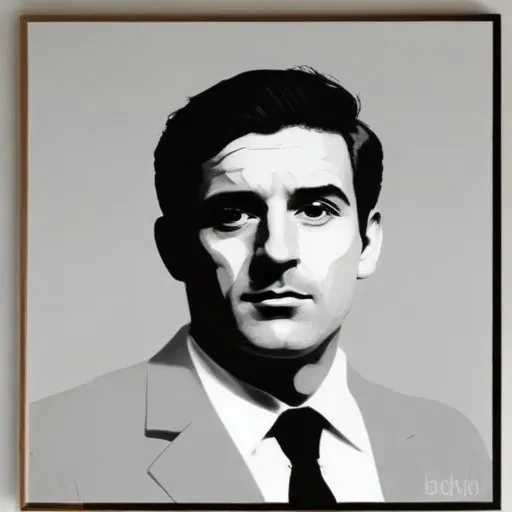
A French photographer celebrated for capturing intimate, poetic, and humanist scenes of everyday life in post-war France, particularly in Paris.
Willy Ronis, a French photographer, is renowned for his captivating black-and-white images that beautifully capture the essence of post-war Paris and Provence. His work is a testament to his poetic eye, which revealed the beauty in the mundane and the extraordinary in the everyday.
Ronis was born on August 14, 1910, in Paris to Jewish immigrants. His father, Emmanuel Ronis, was from Odessa, and his mother, Ida Gluckmann, was from Lithuania. Ronis' early passion was music, and he hoped to become a composer. However, his father's cancer led him to take over the family portrait business in 1932, putting his violin studies on hold.
The work of Alfred Stieglitz and Ansel Adams inspired Ronis to explore artistic photography. He sold the family business after his father's death in 1936 and set up as a freelance photographer. His first work was published in Regards magazine, marking the beginning of his illustrious career.
In 1937, Ronis met David Seymour and Robert Capa, and his work was featured in Plaisir de France magazine in 1938-1939. He reported on a strike at Citron and traveled to the Balkans, honing his skills as a photographer. Ronis was part of the Association des écrivains et Artistes Révolutionnaires, a group that included Henri Cartier-Bresson, and remained a political leftist throughout his life.
In 1946, Ronis joined the photo agency Rapho, alongside Brassa, Robert Doisneau, and Ergy Landau. He was instrumental in forming the professional association Le Groupe des XV and later joined Les 30 x 40, Club Photographique de Paris. This marked a new era in French photography, with Ronis at the forefront.
Ronis' passion for music continued to influence his photography, as seen in his use of composition and light. He remained committed to his artistic vision, refusing to compromise his principles. In 1955, he resigned from Rapho for 25 years after objecting to the hostile captioning of his photograph of a strike by The New York Times.
Ronis' work has had a profound impact on modern photography. His poetic eye and commitment to his artistic vision have inspired generations of photographers. His legacy continues to be felt, with his photographs remaining a testament to his contribution to the world of photography.
"The most difficult thing for me is to photograph someone who is not interesting. I have to find something in them, even if it's just a gesture or an expression."
Ronis' photographs are a reflection of his own words, revealing the beauty in the everyday and the extraordinary in the mundane.
Born in 1908
A pioneer of street photography, capturing life's fleeting moments in elegant, geometric compositions that defined the genre. Known for coining the term "the decisive moment."
Born in 1912
A French photographer and journalist, capturing intimate, humorous, and poignant moments of everyday life in post-war France, particularly in Paris, through his iconic black-and-white images.
Born in 1890
A pioneer of avant-garde photography, this artist experimented with techniques like solarization and rayography, creating surreal, dreamlike images that blurred the line between art and photography.
Born in 1895
Documented the lives of those affected by the Great Depression and the Dust Bowl through powerful, poignant photographs that humanized the struggles of the era. Captured iconic images that shaped the national conversation around poverty and social justice.
Born in 1903
Documenting everyday American life through poignant and influential photographs, capturing the essence of the Great Depression and post-war era.
Born in 1902
Pioneering landscape photographer and conservationist capturing iconic black-and-white images of the American West, advocating for environmental protection through art.
Born in 1904
Pioneering photographer and journalist who captured iconic images of the Great Depression and World War II, and was the first woman to fly on a combat mission.
