


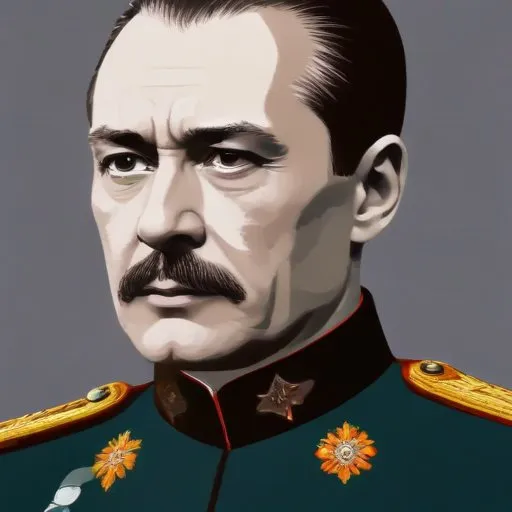
A Russian general who led the White Army during the Russian Civil War, known for his attempts to overthrow the Bolsheviks and restore the Romanov monarchy.
Yevgeny Ludvig Karlovich Miller was a Russian general of Baltic German descent who played a pivotal role in the Russian Civil War as one of the leaders of the anti-communist White Army. Born on October 7, 1867 (O.S. September 25), Miller's military career spanned several decades, taking him from the Russian Imperial Guard to the forefront of the counter-revolutionary movement against the Bolsheviks.
Miller was born in Dnaburg (now Daugavpils), Latvia, into a Baltic German aristocratic family. He graduated from the General Staff Academy and went on to serve with the Russian Imperial Guard. Between 1898 and 1907, he was a Russian military attaché in several European capitals, including Rome, The Hague, and Brussels.
During the First World War, Miller headed the Moscow Military District and the 26th Army Corps, earning a promotion to the rank of lieutenant general. However, his opposition to democratization of the Russian army led to his arrest by his own soldiers after he ordered them to remove red armbands following the February Revolution of 1917.
After the October Revolution of 1917, Miller fled to Archangelsk and was declared Governor-General of Northern Russia. In May 1919, Admiral Kolchak appointed him to replace Vladimir Marouchevsky in charge of the White Army in the region. Miller's anti-Bolshevik Northern Army was supported by the Triple Entente, mostly British forces, in Archangelsk, Murmansk, and Olonets.
However, after an unsuccessful advance against the Red Army along the Northern Dvina in the summer of 1919, British forces withdrew from the region, leaving Miller's men to face the enemy alone. Despite this setback, Miller continued to lead the White Army, earning a reputation as a skilled military strategist and determined opponent of the Bolsheviks.
In February 1920, General Miller, accompanied by 800 refugees, sailed from Archangelsk to Troms, Norway. Later, he moved to France, where he continued his anti-communist activism alongside Grand Duke Nicholas and Pyotr Nikolayevich Wrangel.
Between 1930 and 1937, Miller served as a prominent figure in the Russian émigré community, working tirelessly to promote the anti-Bolshevik cause and advocate for the overthrow of the Soviet government.
In 1937, Miller was kidnapped by Soviet intelligence operatives in Paris, smuggled to the Soviet Union, and subsequently executed in Moscow in 1939. This tragic event marked the end of a remarkable life dedicated to the fight against communism.
Yevgeny Miller's contributions to the anti-Bolshevik movement and his bravery in the face of adversity have cemented his place in history as a champion of counter-revolutionary resistance. Despite the ultimate defeat of the White Army, Miller's legacy continues to inspire those who value freedom and democracy.
In conclusion, Yevgeny Miller's remarkable life and career serve as a testament to the enduring power of courage and conviction in the face of overwhelming adversity. His legacy continues to inspire and educate generations to come.
74 Years Old
A Russian politician who has dominated the country's politics for over two decades, known for his authoritarian leadership style and controversial foreign policy decisions.
61 Years Old
Russian lawyer and politician who served as President of Russia from 2008 to 2012, known for his efforts to modernize Russia's economy and politics. He also served as Prime Minister from 2012 to 2020.
76 Years Old
Russia's top diplomat, responsible for shaping the country's foreign policy and representing its interests on the global stage, known for his sharp wit and tough negotiating style.
85 Years Old
The 37th Prime Minister of Russia, serving from 2007 to 2008, known for his brief tenure and role in Russian politics during Vladimir Putin's presidency. He's a businessman and politician with ties to the energy sector.
75 Years Old
Russia's first post-Soviet foreign minister, known for his pro-Western reforms and efforts to integrate Russia into the global community. He played a key role in shaping Russia's foreign policy in the 1990s.
