


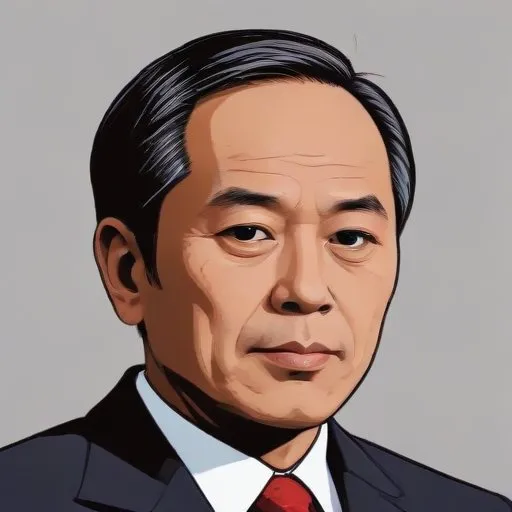
A Japanese politician who served as the Governor of Tokyo from 2014 to 2016, known for his efforts to reform the city's government and prepare for the 2020 Summer Olympics.
Yichi Masuzoe, a Japanese politician and former Governor of Tokyo, is synonymous with controversy and scandal. His meteoric rise to power was matched only by his spectacular fall from grace, leaving behind a trail of corruption allegations and public disillusionment.
Born on November 29, 1948, in Kitakyushu, Fukuoka Prefecture, Masuzoe graduated from Yahata High School in 1967 and went on to study law, politics, and history at the University of Tokyo. He later spent several years in Europe as a research fellow, honing his language skills and becoming conversationally fluent in English and French.
After returning to Japan, Masuzoe became an academic assistant at the University of Tokyo and later an assistant professor. He also established the Masuzoe Institute of Political Economy, which further cemented his reputation as a leading authority on foreign affairs.
Masuzoe's breakthrough came in the 1990s when he relocated to Kitakyushu to care for his aging mother, who was struggling with mental health issues. His experience led to the publication of "When I Put a Diaper on My Mother," a poignant and thought-provoking book that sold over 100,000 copies and propelled him into the national spotlight.
The book's success marked a turning point in Masuzoe's career, as he transitioned from academia to politics. He became a frequent guest on popular TV talk shows, including "TV Tackle" hosted by Takeshi Kitano, and eventually joined the Liberal Democratic Party.
In 2014, Masuzoe was elected as the Governor of Tokyo, a position he held until his resignation in June 2016 amidst allegations of misuse of public funds. During his tenure, he was also a member of the Japanese House of Councillors and served as the Japanese Minister of Health, Labor, and Welfare.
Masuzoe's fall from grace was swift and spectacular. He was accused of using public funds for personal expenses, including luxury travel and entertainment. The allegations led to his resignation and a subsequent investigation, which revealed a pattern of misconduct and abuse of power.
Masuzoe's legacy is a complex and multifaceted one. While his early work on aging and social welfare issues was groundbreaking, his later scandals have overshadowed his achievements. Nevertheless, his rise to prominence serves as a reminder of the importance of accountability and transparency in politics.
In conclusion, Yichi Masuzoe's story serves as a cautionary tale of the dangers of unchecked power and the importance of accountability in politics. While his early work showed promise, his later scandals have left a lasting stain on his legacy.
72 Years Old
The first Japanese leader to visit Pearl Harbor, he strengthened Japan's economy and international relations through bold policies and diplomatic efforts. He's known for his nationalist views and efforts to revise Japan's pacifist constitution.
69 Years Old
The 62nd Prime Minister of Japan, a lawyer-turned-politician who led the country from 2011 to 2012, known for his efforts to rebuild Japan after the devastating Fukushima nuclear disaster. He's also recognized for increasing the country's consumption tax to tackle its massive debt.
80 Years Old
The 61st Prime Minister of Japan, a lawyer-turned-politician who led the country during the 2011 Fukushima Daiichi nuclear disaster, implementing reforms and advocating for renewable energy. He's known for his efforts to phase out nuclear power and promote sustainable energy.
79 Years Old
A Japanese engineer-turned-politician who served as Prime Minister of Japan from 2009 to 2010, known for his efforts to reform the country's economy and politics.
Born in 1919
Served as Prime Minister of Japan from 1991 to 1992, known for his efforts to revitalize the country's economy and his role in shaping Japan's post-Cold War foreign policy.
88 Years Old
A Japanese journalist-turned-politician who served as Prime Minister of Japan from 1993 to 1994, known for his efforts to reform the country's political system and economy.
