


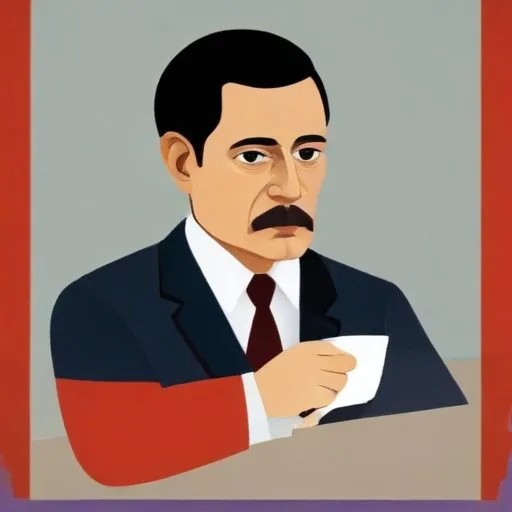
A prominent Russian literary critic, known for his influential essays and reviews that shaped the country's literary landscape in the early 20th century.
Yuly Aykhenvald, a Russian Jewish literary critic, left an indelible mark on the literary world with his unique brand of Aestheticism. Known for his scathing critiques of Russian literary critics, Aykhenvald advocated for an intuitive approach to art, free from social and utilitarian constraints.
Born on January 24, 1872, in Balta, Russian Empire, Aykhenvald was the son of a rabbi. He attended the New Russia University in Odessa, where he developed a lasting interest in the ideas of Arthur Schopenhauer. This philosophical foundation would later shape his literary critiques.
Aykhenvald's literary career spanned multiple decades and numerous pen names, including Yu. Ald and B. Kamenetsky. His literary critiques, though often harsh, were praised by notable authors like Vladimir Nabokov, who likened him to Walter Pater, a prominent English aestheticist.
Aykhenvald's magnum opus was his attack on Russian literary critics, whom he accused of prioritizing social and utilitarian concerns over artistic merit. His essay, "Revolution, the Leaders and the Led," published in 1917, personally targeted Leon Trotsky, earning him a brief arrest and subsequent exile to Germany in 1922.
In Germany, Aykhenvald became involved with several high-profile émigré publications, including the newspaper Rul'. Tragically, his life was cut short by a tram accident in Berlin on December 17, 1928. He was buried in the Russian Orthodox cemetery in Tegel, Berlin.
Aykhenvald's family was marked by intellectual pursuits. His brother, Lev Aikhenvald, was a psychiatrist and author, while his son, Alexander Aikhenvald, was an economist. His grandson, Yury Aikhenvald, became a poet, writer, and dissident. The Aikhenvald family's intellectual legacy continues to this day, with his great-granddaughter, Alexandra Aikhenvald, a linguist.
Aykhenvald's philosophical contributions lie in his advocacy for an intuitive approach to art. He believed that art's essence could only be reached through intuition, rather than rational analysis. This perspective, shaped by Schopenhauer's ideas, continues to influence literary critiques and aesthetic thought.
Aykhenvald's critiques, though controversial in their time, have shaped the way we approach literary analysis today. His emphasis on art's autonomy and the importance of intuition has influenced generations of literary critics, writers, and thinkers.
In conclusion, Yuly Aykhenvald's life and work continue to inspire and challenge us. His unwavering commitment to aesthetic principles and his critiques of literary critics have left an indelible mark on the world of literature and beyond.
Born in 1899
A Russian-born novelist and critic, renowned for crafting intricate, lyrical prose and exploring themes of identity, morality, and the human condition through works like "Lolita" and "Pale Fire".
Born in 1880
A Russian literary giant, known for pioneering the avant-garde movement in literature, blending poetry and prose to create innovative, symbolic works that explored the human experience.
Born in 1893
A Russian avant-garde artist who revolutionized poetry and theater with his bold, futuristic style and passionate performances. He's most famous for his vibrant, propaganda-inspired posters and poems that captured the spirit of the Russian Revolution.
Born in 1899
A Soviet writer and poet, known for his unique blend of realism and mysticism, exploring the human condition and the Russian Revolution in his works. His writing often blurred the lines between poetry and prose, creating a distinctive style.
Born in 1891
A Russian literary mastermind, famous for blending fantasy and realism in works like "The Master and Margarita", which explores the intersection of politics, philosophy, and the human condition.
Born in 1884
A Russian journalist and author who wrote influential dystopian novels, most notably "We", a precursor to George Orwell's "1984".
Born in 1906
A renowned Russian pianist and composer, known for blending classical music with dark humor and satire, creating iconic symphonies and film scores that still resonate today.
