


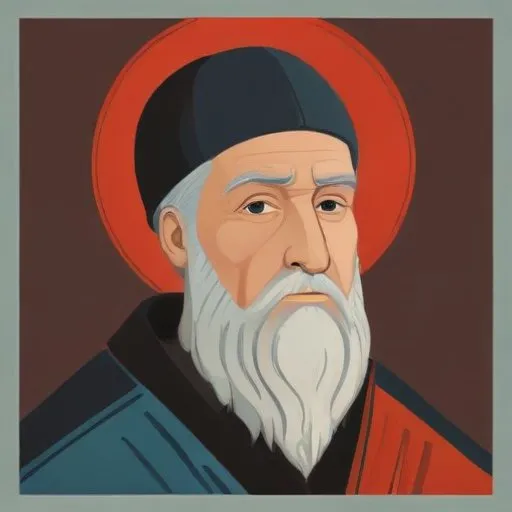
A German Reformation theologian who wrote the Heidelberg Catechism, a foundational document of Calvinist theology still studied today. His work shaped Protestantism and Christian education.
Zacharius Ursinus is perhaps most famously known as the primary author of the Heidelberg Catechism, a fundamental document of the Reformed Christian tradition. Written in 1563, this catechism remains a cornerstone of Reformed theology to this day, and Ursinus' contributions to its creation have had a lasting impact on the Christian faith.
Ursinus was born in 1534 in Breslau, Silesia (now Wroclaw, Poland), to a family of German descent. He received his early education in Breslau and later attended the University of Wittenberg, where he studied theology under the tutelage of Philip Melanchthon, a prominent reformer and colleague of Martin Luther.
Ursinus' most significant theological contribution is undoubtedly the Heidelberg Catechism. This document, written in collaboration with Caspar Olevianus, was commissioned by Frederick III, the Elector of the Palatinate, to provide a unified confession of faith for the Palatinate church. The catechism consists of 129 questions and answers, covering topics such as the nature of God, the person of Jesus Christ, and the importance of faith and repentance.
Ursinus was a vehement opponent of the Lutheran and Catholic views of his time, instead siding with the Calvinist and Reformed traditions. He believed in the authority of Scripture, the sovereignty of God, and the importance of justification by faith alone. His theological views were shaped by his understanding of the Bible, as well as the works of John Calvin and other Reformed thinkers.
In 1561, Ursinus was appointed as a professor of theology at the University of Heidelberg, where he taught alongside Olevianus. This position allowed him to promote his theological views and shape the next generation of Reformed leaders. He remained in this position until his death in 1583.
The Heidelberg Catechism has had a profound impact on modern society, influencing not only Christianity but also Western culture as a whole. The catechism's emphasis on individual faith, personal responsibility, and the authority of Scripture has shaped the modern concept of religiosity. Its influence can be seen in the writings of later theologians, such as Jonathan Edwards and Abraham Kuyper.
Ursinus' commitment to his theological convictions in the face of opposition is an inspiring testament to the power of faith. Despite facing criticism and persecution from Lutheran and Catholic authorities, he remained steadfast in his beliefs, ultimately contributing to the creation of a document that has shaped the Christian faith for centuries.
Zacharius Ursinus' legacy is twofold. Firstly, his work on the Heidelberg Catechism has had a lasting impact on Reformed theology, shaping the faith of millions of Christians worldwide. Secondly, his commitment to his theological convictions serves as an inspiration to Christians everywhere, demonstrating the importance of standing firm in one's beliefs, even in the face of adversity.
Born in 1509
A French pastor and theologian who played a key role in the Protestant Reformation, shaping Christian theology and influencing Western civilization. He's famous for his teachings on predestination and his role in establishing Calvinism.
Born in 1483
A German monk and priest who sparked the Protestant Reformation, challenging Catholic Church authority and shaping Western Christianity. He's famous for nailing 95 theses to a church door, sparking a religious revolution.
Born in 1484
Leader of the Swiss Reformation, advocating for church reform and inspiring other Protestant movements.
Born in 1497
A 16th-century Renaissance scholar who made significant contributions to the development of the Protestant Reformation and education, known for his theological writings and astronomical observations.
Born in 1504
A prominent figure in the Swiss Reformation, he played a key role in shaping Protestant theology and wrote influential works on covenant theology. His writings had a lasting impact on Reformed Christianity.
Born in 1519
A 16th-century French theologian and scholar who played a key role in shaping Protestantism, particularly Calvinism, through his writings and teachings. He's also known for his Greek New Testament translation.
