


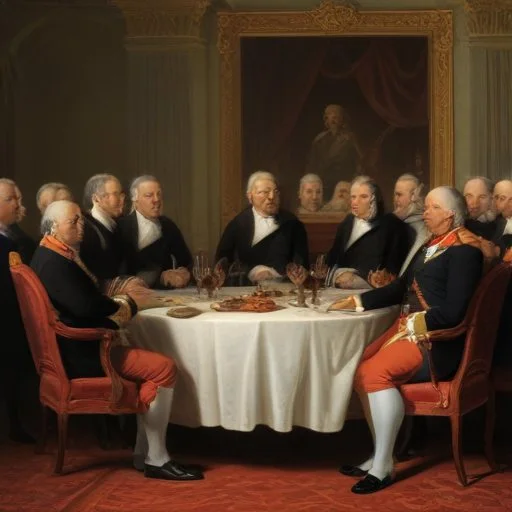
One of the key figures involved in the negotiations of the First Treaty of Paris was Lord Castlereagh, the British Foreign Secretary. Castlereagh was a skilled diplomat who played a crucial role in shaping the treaty's terms. Born in 1769, Castlereagh was a member of the Anglo-Irish aristocracy and had a long and distinguished career in politics. He was known for his pragmatism and his ability to bring people together, skills that served him well in the complex negotiations leading up to the treaty.
Despite his many accomplishments, Castlereagh was not without his critics. Some saw him as too soft on Napoleon, and argued that the treaty did not go far enough in punishing the French leader for his aggression. However, Castlereagh's defenders argue that his approach was necessary to bring a lasting peace to Europe.

The First Treaty of Paris marked a significant shift in the balance of power in Europe. For the first time in over two decades, France was no longer the dominant power on the continent. Instead, the treaty recognized the emergence of new powers, such as Russia and Prussia, and marked a new era of cooperation and diplomacy.
In many ways, the treaty can be seen as a response to the instability and chaos of the Napoleonic Wars. The European powers recognized that the old system of rival alliances and balance of power politics was no longer sustainable, and that a new approach was needed. The treaty marked a move towards a more collaborative and cooperative approach to international relations, one that would shape European politics for generations to come.
The First Treaty of Paris was signed against the backdrop of a rapidly changing geopolitical landscape. The Napoleonic Wars had redrawn the map of Europe, and the old certainties of the pre-revolutionary era were no longer applicable. The treaty marked a recognition of this new reality, and an attempt to establish a new order that would provide stability and security for the continent.
In this sense, the treaty can be seen as a response to the crisis of the old regime, and an attempt to create a new system of international relations that would prevent future conflicts. The treaty's emphasis on cooperation and diplomacy marked a significant shift away from the rivalries and alliances of the past, and towards a more collaborative and cooperative approach to international relations.
The First Treaty of Paris had a profound impact on the cultural landscape of Europe. The treaty marked a turning point in the Romantic era, and the end of the Napoleonic Wars saw a renewed interest in art, literature, and music. The treaty's emphasis on cooperation and diplomacy also marked a shift towards a more cosmopolitan and international cultural scene.
The treaty also marked a significant turning point in the development of national identities. The redrawing of the map of Europe and the emergence of new powers marked a recognition of the importance of national identity and self-determination. This, in turn, led to a renewed interest in national cultures and traditions, and a more pronounced sense of national pride and identity.
The First Treaty of Paris marked a significant turning point in the economic history of Europe. The treaty's recognition of the emergence of new powers, such as Russia and Prussia, marked a shift towards a more multipolar economic system. The treaty also marked a recognition of the importance of trade and commerce in maintaining peace and stability on the continent.
The treaty's provisions for the restoration of the French monarchy and the redrawing of European borders also had significant economic implications. The treaty marked a return to a more traditional system of mercantilism, with countries seeking to protect their own economic interests and promote their own trade and commerce. This, in turn, led to a renewed interest in economic nationalism and protectionism, and a more pronounced sense of economic rivalry between nations.