


The year 1533 marked a pivotal moment in English history as the marriage of King Henry VIII to Catherine of Aragon was declared null and void, a decision that would have far-reaching consequences for the Tudor dynasty, the Church of England, and the course of European politics.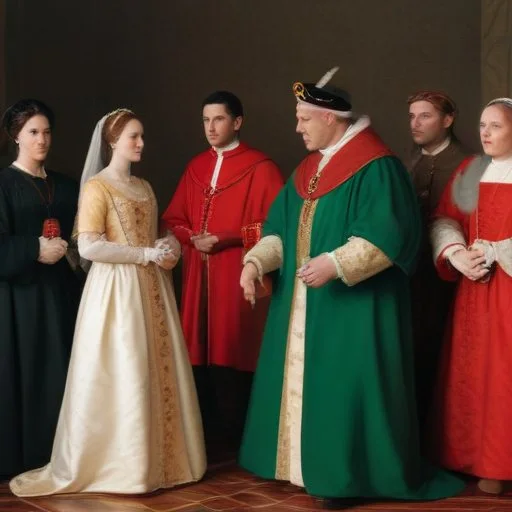
Henry VIII's desire for a male heir had long been a source of tension in his marriage to Catherine of Aragon, the daughter of King Ferdinand II of Aragon and Queen Isabella I of Castile. Despite multiple pregnancies, Catherine had failed to produce a male successor, leading Henry to become increasingly disillusioned with their union.
Against this backdrop of marital discord, Henry's eyes began to wander, fixating on one of Catherine's ladies-in-waiting, Anne Boleyn. The clever, charming, and assertive Anne quickly won Henry's heart, and the King became determined to marry her and secure a male heir.
Henry's desire for an annulment was met with resistance from Pope Clement VII, who refused to grant the King's request. This refusal led Henry to break away from the authority of the Roman Catholic Church, establishing the Church of England with himself at its head. This seismic shift in power marked the beginning of the English Reformation and had significant implications for the kingdom.
The nullification of Henry's marriage to Catherine of Aragon had far-reaching consequences, including:
The nullification of Henry's marriage to Catherine of Aragon sent shockwaves through European society, contributing to a wider cultural and social shift towards Protestantism and the rejection of papal authority.
As Henry's marriage was declared null and void, the stage was set for a dramatic and tumultuous era in English history, one marked by political intrigue, personal scandal, and religious upheaval.
The nullification of Henry VIII's marriage to Catherine of Aragon remains one of the most significant events in English history, a testament to the intrigue, drama, and power struggles that characterized the Tudor dynasty's reign.
Catherine of Aragon, the daughter of King Ferdinand II of Aragon and Queen Isabella I of Castile, was born in 1485 in Alcalá de Henares, Spain. She was raised with a strong sense of duty and Catholicism, which would shape her later life as the Queen of England.
Catherine's marriage to Henry VIII was initially a happy one, with the couple sharing a deep affection for each other. However, as her failure to produce a male heir became apparent, Catherine's position in the kingdom began to weaken.
Despite her eventual downfall, Catherine remained loyal to her husband and the Catholic Church, refusing to acknowledge the annulment of their marriage. This unwavering commitment to her faith would earn her the admiration of many, including her daughter Mary, who would later become Queen Mary I of England.

Historians have long debated the true motives behind Henry VIII's desire to annul his marriage to Catherine of Aragon. While some argue that Henry's primary concern was securing a male heir, others believe that his desire for Anne Boleyn played a significant role in his decision.
Some historians, such as G.R. Elton, have suggested that Henry's break with Rome was a calculated move to consolidate his power and establish the Tudor dynasty as a major force in European politics.
Others, like David Starkey, have emphasized the importance of Henry's personal relationships, including his infatuation with Anne Boleyn, in shaping his decision to seek an annulment.
Henry VIII's annulment of his marriage to Catherine of Aragon shares striking similarities with modern-day divorce proceedings. Just as Henry cited the invalidity of his marriage due to Catherine's previous marriage to his brother, modern couples often cite irreconcilable differences or the failure to consummate their marriage as grounds for divorce.
In both cases, the desire for a new partner or the need to secure a better social or economic position drives the decision to end the marriage. However, while modern divorce laws prioritize the well-being of all parties involved, Henry's annulment was driven by his own self-interest and desire for power.

Henry VIII's annulment of his marriage to Catherine of Aragon had a profound impact on English culture, paving the way for the English Reformation and the establishment of the Church of England.
The upheaval caused by the annulment also led to a shift in artistic and literary expression, as writers and artists began to explore themes of identity, power, and morality in their work.
The legacy of Henry's annulment can be seen in the many plays, novels, and films that continue to retell the story of the Tudor dynasty, cementing its place in the popular imagination.
Henry VIII's annulment of his marriage to Catherine of Aragon took place against the backdrop of a rapidly changing European landscape. The rise of Protestantism and the decline of the Holy Roman Empire created an atmosphere of uncertainty and upheaval.
In this context, Henry's decision to break with Rome and establish the Church of England was a bold move that Realigned England's position within the European power structure.
The annulment also marked the beginning of a long period of rivalry between England and Spain, as the two powers vied for dominance on the European stage.