


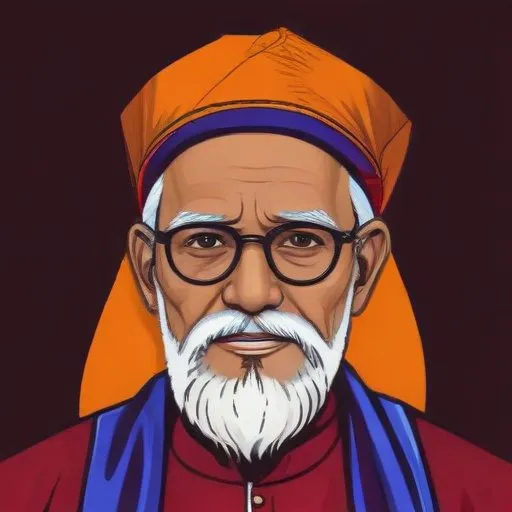
A renowned Islamic theologian and scholar who wrote extensively on Islamic philosophy, jurisprudence, and Sufism, leaving a lasting impact on Indian Muslim thought.
Known for his groundbreaking work in synthesizing Sufi and Shariah thought, Abdul Haq Ansari is a renowned Indian Islamic scholar who has left an indelible mark on the world of Islamic studies. As the former Amir of JamaateIslami Hind (JIH) and Chancellor of Al Jamia Al Islamia, Kerala, Ansari's contributions to Islamic philosophy, education, and literature are unparalleled.
Born on September 1, 1931, Ansari pursued his Alimiyat from Darsgah Islami, Rampur, and later studied Arabic, Philosophy, and History at Aligarh Muslim University, obtaining his B.A. in 1957. He furthered his education by earning an M.A. in Philosophy from Aligarh Muslim University in 1959 and a Ph.D. in Philosophy in 1962.
Ansari's academic career is replete with accomplishments, having served as Professor and Head of the Department of Arabic, Persian, and Islamic Studies at Vishwa Bharti University (1965-1978). He also taught Islamic Studies at Sudan University (1978-1981), Dhahran University (1982-1985), and Imam Muhammad Bin Saud University, Riyadh (1985-1995). Ansari has presented numerous papers at international and national conferences, including the Orientalist Conference in New Delhi (1964).
Ansari's magnum opus, Sufism and Shariah, is a seminal work that harmoniously blends Sufi and Shariah thought, showcasing his in-depth engagement with kalam, tasawwuf, and fiqh in Islamic history. Additionally, he wrote a book on Mishkawah's philosophy and an English translation of Ibn Taymiyyah's fatwas with an introduction. His Learning the Language of Quran is considered one of the best English guides for beginners learning to read the Quran.
In New Delhi, Ansari established the Islami Academy, which aimed to train graduates from secular educational backgrounds in Islamic Sciences based on the madrasa curriculum. This pioneering initiative has had a profound impact on Islamic education and scholarship.
Ansari's contributions to Islamic studies and education have been recognized through various awards and honors, including his appointment as the Chancellor of Al Jamia Al Islamia, Kerala.
Ansari's work is characterized by a deep understanding of Islamic philosophy, particularly in the realms of kalam, tasawwuf, and fiqh. His synthesis of Sufi and Shariah thought has enriched the landscape of Islamic studies, providing a unique perspective on the intersection of spirituality and jurisprudence.
Abdul Haq Ansari's remarkable life and contributions have left an enduring impact on Islamic studies, education, and philosophy. His groundbreaking work continues to inspire and enrich the lives of scholars and students alike.
Born in 1876
Leader of the All-India Muslim League, instrumental in the creation of Pakistan, and its first head of state. He's revered as the "Father of the Nation" in Pakistan.
Born in 1869
Indian freedom fighter, activist, and philosopher who led India to independence from British rule through non-violent civil disobedience, inspiring civil rights movements worldwide.
Born in 1889
India's first Prime Minister, a key figure in the country's struggle for independence from British rule, and a champion of democracy and secularism. He played a crucial role in shaping modern India's government and economy.
Born in 1904
The second Prime Minister of India, leading the country through a tumultuous period, including a war with Pakistan, and known for his simplicity, honesty, and dedication to the nation. He is also credited with promoting the Green Revolution, which transformed India's agricultural sector.
Born in 1917
The first female Prime Minister of India, serving from 1966 to 1977 and again from 1980 until her assassination in 1984, known for her strong leadership and economic reforms.
Born in 1884
India's first president, a key figure in the country's struggle for independence, who played a crucial role in shaping the nation's early years. He's revered for his leadership and commitment to democracy.
Born in 1879
A pioneering Indian poet and activist who used her lyrical voice to advocate for women's rights and Indian independence, leaving a lasting legacy in Indian literature and politics.
