


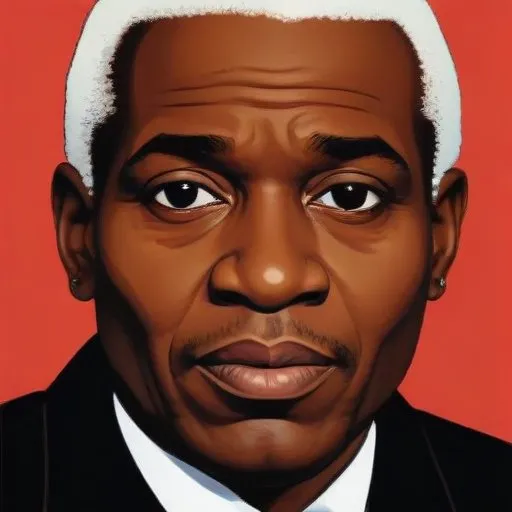
Ivorian-French author and playwright celebrated for his unique blend of traditional African storytelling and modern European literary styles, exploring themes of identity, culture, and colonialism.
Ahmadou Kourouma, the renowned Ivorian novelist, is known for his poignant and thought-provoking works that spoke truth to power, shedding light on the plight of African nations during the tumultuous post-colonial era. Through his vivid storytelling, Kourouma brought to life the struggles, hopes, and despairs of a continent grappling with the aftermath of colonial rule.
Born on November 24, 1927, in Boundiali, Côte d'Ivoire, Kourouma was raised by his uncle and initially pursued studies in Bamako, Mali. He later participated in French military campaigns in Indochina from 1950 to 1954, only to return to France to study mathematics in Lyon. The path he chose, however, was far from ordinary.
Upon Côte d'Ivoire's independence in 1960, Kourouma returned home, but soon found himself at odds with the government of Félix Houphouët-Boigny. His dissent led to brief imprisonment, followed by years of exile in Algeria, Cameroon, and Togo. During this tumultuous period, Kourouma turned to fiction as a means of expressing his disillusionment with the betrayal of African aspirations.
Kourouma's debut novel, Les Soleils des indépendances (The Suns of Independence, 1970), was a searing critique of postcolonial governments in Africa. This groundbreaking work set the tone for his subsequent novels, which tackled the complexities of colonialism, national identity, and the human condition.
Kourouma's works are not merely entertaining; they are a testament to his unwavering commitment to social justice and his unrelenting critique of power structures that perpetuate inequality.
Kourouma's contributions to literature have been recognized with several awards, including the Prix du Livre Inter in 1990 for Monn, outrages et défis.
Kourouma's unyielding stance against the Ivorian government and his advocacy for Pan-Africanism often led to controversy. His outspoken nature and willingness to challenge the status quo earned him both admiration and resentment.
Despite the challenges he faced, Kourouma remained steadfast in his pursuit of truth and justice. His passing on December 11, 2003, marked the end of an era, but his legacy lives on through his works, which continue to inspire generations of writers, activists, and thinkers.
Kourouma's influence on modern African literature cannot be overstated. His commitment to social justice, his critique of power structures, and his poignant storytelling have inspired a new generation of writers to speak truth to power.
As we reflect on Kourouma's life and works, we are reminded of the power of literature to spark change, to challenge the status quo, and to inspire a more just and equitable world.
Born in 1905
Existentialist philosopher and playwright who argued that humans have complete freedom to choose their actions and create their own meaning in life, influencing modern thought on morality and individual responsibility.
Born in 1913
A French novelist, philosopher, and journalist who wrote influential works like "The Stranger" and "The Plague", exploring absurdism and the human condition.
Born in 1925
A psychiatrist and philosopher who wrote about the psychological effects of colonialism and racism, advocating for violent revolution to overthrow oppressive systems.
Born in 1923
A pioneering scholar who merged anthropology, history, and physics to reclaim and redefine African cultural heritage and identity, challenging prevailing Eurocentric narratives.
92 Years Old
A Nigerian literary giant, renowned for his powerful writings that explore the complexities of African identity, culture, and politics. His works often blend traditional Yoruba mythology with modernist experimentation.
96 Years Old
A renowned African literary voice, celebrated for his poignant and thought-provoking works that explore the complexities of Nigerian culture and the human experience.
