


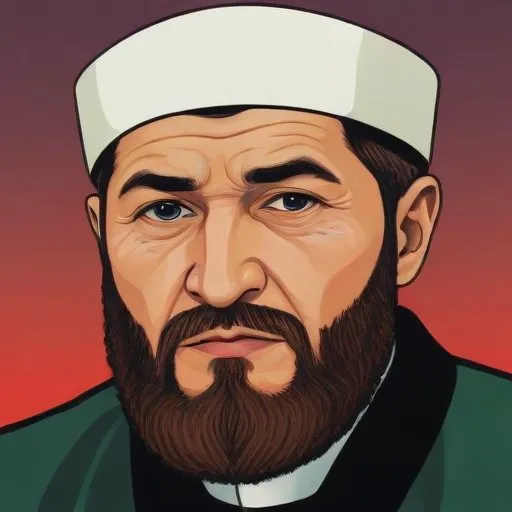
First President of the Chechen Republic, a cleric-turned-politician who played a crucial role in Chechnya's turbulent history, bridging the gap between separatist rebels and the Russian government. He's known for his efforts to bring stability to the war-torn region.
Akhmad Kadyrov is known for his dramatic shift in allegiance during the Chechen Wars, serving as the Chief Mufti of the Chechen Republic of Ichkeria and later becoming the President of the Chechen Republic, loyal to the Russian government. His tumultuous career was marked by violent conflicts, power struggles, and ultimately, his assassination in 2004.
Akhmad Kadyrov was born on August 23, 1951, in Karaganda, Kazakhstan, to a Chechen family that had been expelled from Chechnya during the deportation of the Chechens and Ingush. In 1957, his family returned to Shalinsky District of the Chechen-Ingush ASSR.
Kadyrov pursued higher education in Islamic studies, enrolling in Miri Arab Madrasah in Bukhara in 1980 and later at the Islamic University in Tashkent, Uzbek SSR, from 1982 to 1986.
After returning to Chechnya in the early 1990s, Kadyrov founded the Islamic Institute in the village of Kurchaloy. He became a supporter of President Dzhokhar Dudayev and actively participated in the First Chechen War on the Chechen side as a militia commander.
In 1995, Kadyrov was appointed Chief Mufti of the Chechen Republic of Ichkeria and Chairperson of the Spiritual Administration of the Muslims of the Chechen Republic. During this period, he made controversial statements, including "There are a million Chechens, and 150 million Russians. If every Chechen kills 150 Russians, we will win."
At the outbreak of the Second Chechen War, Kadyrov unexpectedly switched sides, offering his services to the Russian government. He became the head of administration in July 2000 and later, the President of the Chechen Republic on October 5, 2003.
Akhmad Kadyrov was assassinated on May 9, 2004, by Chechen Islamists during a Victory Day memorial parade in Grozny. His son, Ramzan Kadyrov, succeeded him as the President of the Chechen Republic in March 2007.
Kadyrov's shift in allegiance and cooperation with the Russian government have been widely criticized. Many have accused him of betraying the Chechen people and contributing to the Russian government's oppression of the region.
Akhmad Kadyrov's life and career are a reflection of the complex and tumultuous history of the Chechen region. His legacy remains controversial, with some viewing him as a traitor and others as a pragmatist who sought to bring stability to the war-torn region.
Kadyrov's story serves as a reminder of the devastating consequences of conflict, the importance of understanding the complexities of human allegiance, and the lasting impact of individual actions on the course of history.
50 Years Old
A strongman leader who ruled Chechnya with an iron fist, known for his brutal suppression of opposition and alleged human rights abuses. 18
74 Years Old
A Russian politician who has dominated the country's politics for over two decades, known for his authoritarian leadership style and controversial foreign policy decisions.
61 Years Old
Russian lawyer and politician who served as President of Russia from 2008 to 2012, known for his efforts to modernize Russia's economy and politics. He also served as Prime Minister from 2012 to 2020.
95 Years Old
First President of Russia, leading the country's transition from communism to democracy, and known for his bold reforms and iconic leadership style.
95 Years Old
The last leader of the Soviet Union, who introduced reforms that led to the end of the Cold War and the collapse of communism, earning a Nobel Peace Prize. He's known for his policies of glasnost and perestroika, which transformed the Soviet Union and the world.
88 Years Old
A Russian politician who served as Prime Minister from 1992 to 1998, known for his role in shaping post-Soviet Russia's economy and politics.
96 Years Old
A Ukrainian-Russian journalist and politician who served as Russia's Prime Minister from 1998 to 1999, known for his efforts to stabilize the country's economy and foreign policy during a tumultuous period.
81 Years Old
Russian Minister of Foreign Affairs from 1998 to 2004, known for playing a key role in shaping Russia's foreign policy and international relations during a pivotal period. He was a skilled diplomat who navigated complex global issues.
