


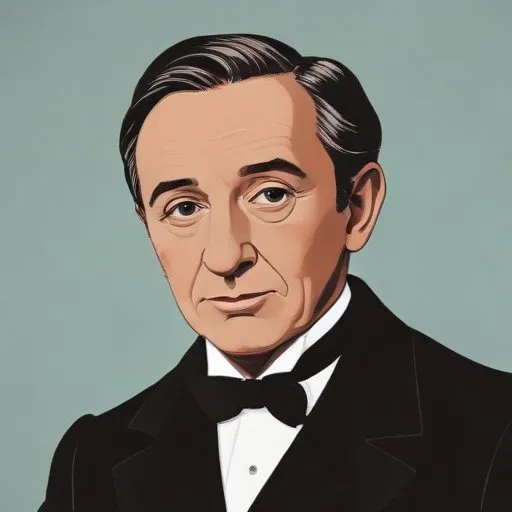
A British composer and conductor, known for his work with the London Symphony Orchestra and his compositions that blended classical and modern styles.
Albert Coates was a renowned English conductor and composer, best known for his mastery of opera and Russian repertoire. With a career spanning over four decades, he left an indelible mark on the world of classical music, particularly in the UK and continental Europe.
Born on July 11, 1882, in Saint Petersburg, Russia, Coates was the youngest of seven sons to an English father, Charles Thomas Coates, and a mother of British descent, Mary Ann Gibson. He began learning music at a young age, studying the violin, cello, and piano in Russia before moving to England at the age of 12.
Coates attended the Liverpool Institute High School for Boys and the Royal Naval College, Dartmouth, before pursuing a degree in science at Liverpool University. However, his true passion lay in music, and he eventually returned to Russia to study composition with the legendary Nikolai Rimsky-Korsakov.
Coates' conducting career began in earnest when he attended the Leipzig Conservatory, where he studied under the tutelage of Artur Nikisch. Nikisch, impressed by Coates' talent, appointed him as his répétiteur (assistant conductor), and it was during this period that Coates developed his skills as a conductor.
Coates' breakthrough in England came in 1914, when he conducted Wagner's opera at the Royal Opera House, Covent Garden. His success led to his appointment as the chief conductor of the London Symphony Orchestra in 1919. Although he failed to secure a permanent conductorship in the UK after 1923, he went on to have a prolific guest-conducting career in continental Europe and the US.
As a composer, Coates wrote seven operas, with his most notable work being Pickwick, which premiered at the Royal Opera House, Covent Garden, in 1936. Pickwick holds the distinction of being the first opera to be televised on the BBC, a milestone in the history of broadcasting.
Coates' compositional style was characterized by his mastery of Russian and German influences, which is evident in his operatic works. Although his compositional output was not as extensive as his conducting career, his operas remain a testament to his skill and craftsmanship.
Albert Coates' legacy lies in his contributions to the world of opera and classical music. He was a pioneer in promoting Russian repertoire in the UK, and his work with the London Symphony Orchestra helped to establish it as a premier orchestra.
Coates' influence can be seen in the many conductors and musicians he inspired during his lifetime. His passion for music and his dedication to his craft have left an indelible mark on the world of classical music.
Albert Coates passed away on December 11, 1953, at the age of 71, leaving behind a legacy that continues to inspire and influence musicians to this day.
Born in 1857
A renowned composer and educator, best known for his iconic orchestral works, including the majestic "Pomp and Circumstance" march, which is a staple at graduations worldwide.
Born in 1872
A renowned composer and educator, he's celebrated for his symphonies and folk-song inspired works that evoke a sense of English heritage and nostalgia. His music is a testament to his love for his homeland's cultural roots.
Born in 1902
A renowned composer of orchestral and choral works, particularly famous for his iconic score for Laurence Olivier's 1944 film "Henry V" and his ceremonial music for British coronations.
Born in 1913
A renowned musician who masterfully blended classical and opera styles, creating iconic works like "Peter Grimes" and "The Young Person's Guide to the Orchestra".
Born in 1874
A renowned composer and educator, best known for his orchestral suite "The Planets", which evokes a sense of cosmic wonder and exploration. His music is a staple of classical repertoire, still widely performed today.
Born in 1862
A pioneering composer of the early 20th century, known for his impressionistic and expressive works that evoke a sense of nature and the human experience. His music is characterized by lush harmonies and orchestration.
Born in 1848
A renowned composer and music historian, he's credited with elevating British music to international prominence, particularly through his iconic "Jerusalem" anthem.
Born in 1852
A renowned Irish composer, conductor, and educator who made significant contributions to the development of classical music, particularly in the UK and Ireland, and is remembered for his iconic choral works and operas.
