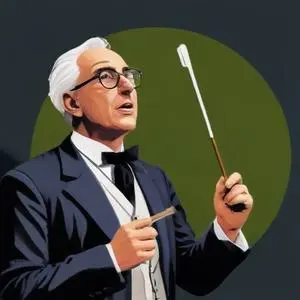
Frederick Delius: The Composer Who Defied Convention
A Musical Trailblazer
Frederick Delius, a renowned English composer, is best known for his unique and innovative musical style that blended African-American influences with European classical traditions. Born on January 29, 1862, in Bradford, England, Delius went on to defy convention, rejecting a life of commerce to pursue his passion for music.
The Road to Composition
In 1884, Delius was sent to Florida to manage an orange plantation. However, his time in the United States was marked by a newfound interest in African-American music, which would later greatly influence his compositions. By 1886, he had abandoned his managerial duties and returned to Europe, where he began to formalize his musical education in Germany.
Early Successes and Inspirations
Delius' initial successes came in Germany, where conductors like Hans Haym promoted his music from the late 1890s onwards. His early compositions reflected the musical influences he had experienced in America, as well as those of European composers such as Grieg and Wagner. As his skills matured, Delius developed a distinctive style characterized by individual orchestration and chromatic harmony.
A Mass of Life and A Village Romeo and Juliet
Two of Delius' most notable works are
A Mass of Life and
A Village Romeo and Juliet. The full premiere of
A Mass of Life took place in London in 1909, conducted by
Thomas Beecham, who had premiered Part II in Germany in 1908. Beecham also staged
A Village Romeo and Juliet at Covent Garden in 1910, further solidifying Delius' reputation as a composer.
Later Years and Legacy
After 1918, Delius' health began to decline due to syphilis, contracted during his earlier years in Paris. Despite becoming paralyzed and blind, Delius continued to compose with the aid of an amanuensis,
Eric Fenby, until his death on June 10, 1934. Delius' music, though not consistently popular, has had a lasting impact on the classical music world.
Personal Milestones and Key Life Events
- 1862: Born on January 29th in Bradford, England
- 1884: Sent to Florida to manage an orange plantation
- 1886: Returned to Europe to formalize his musical education
- 1890s: Initial successes in Germany
- 1907: Music begins to receive regular performances in Britain
- 1909: Full premiere of A Mass of Life in London
- 1910: Premiere of A Village Romeo and Juliet at Covent Garden
- 1918: Began to suffer from syphilis
- 1928-1932: Completed late compositions with Eric Fenby's assistance
- 1934: Died on June 10th
Influence on Modern Society
Delius' unique blend of African-American and European influences has inspired generations of composers, including those associated with the BBC's Delius Society. His music continues to be performed and celebrated around the world, ensuring his legacy as a composer who defied convention and pushed the boundaries of classical music.
FAQ
What are some of Frederick Deliuss most famous compositions?
Frederick Delius was a prolific composer, and some of his most famous works include On Hearing the First Cuckoo in Spring and La Calinda.
How did Frederick Deliuss travels influence his music?
Frederick Deliuss travels to Germany, France, and the United States had a profound impact on his music, exposing him to new styles and influences that shaped his compositional voice.
What was Frederick Deliuss musical style?
Frederick Deliuss musical style was characterized by its lyricism, sensuality, and use of rich harmonies, which created a unique and expressive sound.
How did Frederick Deliuss relationships with other artists impact his work?
Frederick Deliuss relationships with other artists, including his wife Jelka Rosen and the conductor Thomas Beecham, had a significant impact on his work, as they provided him with support and encouragement.
What was Frederick Deliuss legacy in the world of classical music?
Frederick Deliuss legacy in the world of classical music is one of innovation, experimentation, and beauty, as he pushed the boundaries of traditional forms and created a unique and lasting body of work.