


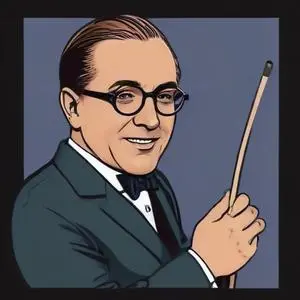
A renowned British conductor, known for founding the London Philharmonic Orchestra and promoting classical music to a wider audience through affordable concerts.
Thomas Beecham, 2nd Baronet, CH, was a renowned English conductor and impresario, best known for his associations with the London Philharmonic and the Royal Philharmonic orchestras. With a career spanning over six decades, Beecham was a major influence on the musical life of Britain, earning the title of Britain's first international conductor.
Born on April 29, 1879, in St. Helens, Lancashire (now Merseyside), Beecham was part of a wealthy industrial family. His grandfather, Thomas Beecham, had founded the Beecham's Pills laxative factory, which provided the family with a comfortable fortune. This financial security allowed Beecham to pursue his passion for music without worrying about financial constraints.
Beecham began his career as a conductor in 1899, using his family's wealth to finance opera productions from the 1910s until the start of World War II. He staged seasons at Covent Garden, Drury Lane, and His Majesty's Theatre, featuring international stars and a wide repertoire.
Beecham was instrumental in introducing several operas to England, including Richard Strauss's Elektra, Salome, and Der Rosenkavalier, as well as three operas by Frederick Delius.
Alongside Malcolm Sargent, Beecham founded the London Philharmonic in 1932, conducting its first performance at the Queen's Hall. During the 1940s, he worked in the United States, serving as music director of the Seattle Symphony and conducting at the Metropolitan Opera.
After his return to Britain, Beecham founded the Royal Philharmonic in 1946, conducting it until his death in 1961. His eclectic repertoire featured composers such as Haydn, Schubert, Sibelius, and Mozart, whom he revered above all others.
Beecham was known for his advocacy of lesser-known composers and his willingness to take risks in his performances. He believed that music should be accessible to everyone, not just the elite, and worked tirelessly to promote classical music to a wider audience.
Beecham's legacy extends beyond the world of classical music. He played a significant role in shaping Britain's cultural identity, promoting classical music and making it more accessible to the masses. His advocacy for lesser-known composers and his willingness to take risks in his performances have inspired generations of musicians and music lovers alike.
"I would much rather be a conductor than a king."
"The only thing I can do is to try to give the public what they want, and that is music."
Thomas Beecham's life and career spanned a tumultuous period in world history, including two World Wars and the Great Depression. Despite these challenges, he remained committed to his craft, using his platform to promote classical music and bring people together. His legacy continues to inspire and influence musicians, conductors, and music lovers around the world.
Beecham was appointed a Companion of Honour (CH) in 1957, a testament to his outstanding contributions to British music.
Born in 1809
A renowned 19th-century musician who masterfully blended classical and romantic styles, creating iconic works like the "Wedding March" and "Elijah" oratorio. His compositions continue to inspire and influence generations of artists.
Born in 1803
A French Romantic-era mastermind who composed iconic symphonies, operas, and orchestral works, revolutionizing classical music with his bold, expressive style.
Born in 1860
A visionary composer and conductor who expanded symphonic music's emotional depth and complexity, creating works of profound beauty and intensity.
Born in 1864
A renowned composer and conductor of the late Romantic era, known for his tone poems and operas that showcased his mastery of orchestration and expressive storytelling.
Born in 1873
A renowned Russian musician who composed iconic symphonies and piano concertos, and was also a skilled pianist and conductor, leaving a lasting legacy in classical music.
Born in 1865
A Finnish master of classical music, renowned for his symphonies and tone poems that evoke the mystique of his native land. His iconic works, such as "Finlandia," have become synonymous with Finnish culture.
Born in 1862
A pioneering composer of the early 20th century, known for his impressionistic and expressive works that evoke a sense of nature and the human experience. His music is characterized by lush harmonies and orchestration.
Born in 1902
A renowned composer of orchestral and choral works, particularly famous for his iconic score for Laurence Olivier's 1944 film "Henry V" and his ceremonial music for British coronations.
