


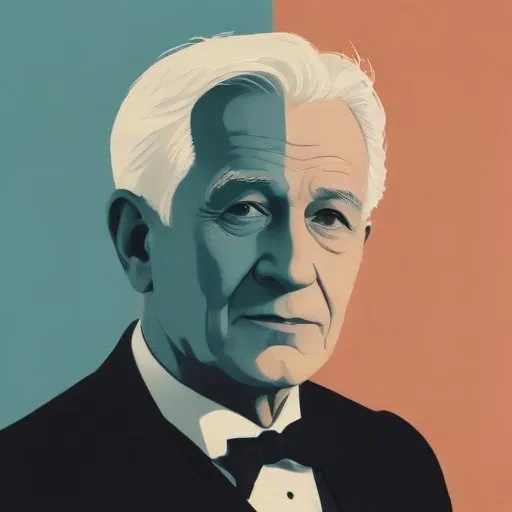
A radical libertarian thinker who critiqued modern society and advocated for individual freedom and limited government intervention. He's known for his influential writings on politics, economics, and culture.
Known for his devout libertarian stance and scathing critique of government intervention, Albert Jay Nock was a prominent American author, editor, and social critic of the early 20th century. Through his works, he emerged as a fundamental inspiration for the modern libertarian and conservative movements, earning recognition as one of the first Americans to self-identify as libertarian.
Born on October 13, 1870, in Scranton, Pennsylvania, Nock's life was a tapestry of seeming contradictions. His father, Joseph Albert Nock, was both a steelworker and an Episcopal priest, instilling in him a strong sense of morality and social responsibility. Raised in Brooklyn, New York, Nock's early years were marked by a strong sense of intellectual curiosity and a passion for learning.
After graduating from St. Stephens College (now Bard College) in 1888, Nock's life took an unexpected turn. He pursued a brief career in minor league baseball, showcasing his athletic prowess before eventually turning to more academic pursuits.
In 1897, Nock was ordained as an Episcopal priest, but his true calling lay in writing. He began his journalistic career in 1909, leaving behind the ministry and his family. This marked the beginning of a lifelong journey as a social critic and commentator.
In 1914, Nock joined the staff of The Nation magazine, which at the time was more aligned with liberal capitalism. During this period, he befriended influential politicians like William Jennings Bryan and developed close relationships with leading proponents of the Georgist movement, including his lifelong admiration for Henry George.
Nock's most notable works, Memoirs of a Superfluous Man and Our Enemy, the State, are testaments to his unwavering commitment to individual liberty and limited government intervention. His writings not only influenced the development of modern libertarian thought but also resonated with prominent figures like William F. Buckley Jr.
Nock's outspoken opposition to the New Deal and government overreach earned him both accolades and criticism. Through his writing, he championed individual freedom and criticized the erosion of personal liberties in the face of growing government control.
Albert Jay Nock's unwavering dedication to individual liberty and limited government intervention has had a profound impact on modern society. His influence can be seen in the development of libertarian and conservative thought, and his works continue to inspire and educate generations of scholars, policymakers, and social critics.
Nock's life and works must be viewed in the context of the tumultuous early 20th century, marked by World War I, the rise of socialism, and the growing importance of government intervention in economic affairs. His thought-provoking critiques of government overreach and championing of individual liberty have drawn comparisons to other influential thinkers of his time, including Henry George and Lysander Spooner.
Through his remarkable life and works, Albert Jay Nock has left an indelible mark on modern society, cementing his place as one of the most influential libertarian thinkers of the 20th century.
Born in 1880
A satirical journalist and social critic who ridiculed American culture and politics, known for his witty writings and sharp commentary on the human condition.
Born in 1905
Russian-born American novelist and philosopher who wrote influential novels like "The Fountainhead" and "Atlas Shrugged", promoting individualism and capitalism.
Born in 1926
A prominent figure in the Austrian School of economics, known for his libertarian and anarchist views, and his work on the history of economic thought.
Born in 1881
A pioneer of Austrian economics, he developed the concept of praxeology, which focuses on human action and its consequences, and is known for his critiques of socialism and central planning.
Born in 1899
Austrian economist and philosopher who championed free market capitalism and limited government intervention, warning of the dangers of socialism and totalitarianism. His work influenced economic policy and shaped modern libertarian thought.
Born in 1903
A renowned writer of dystopian classics, such as "1984" and "Animal Farm", who warned of totalitarianism's dangers through allegorical fiction.
Born in 1894
Author of dystopian classics like Brave New World, exploring the consequences of technological advancements on humanity. Known for prophetic warnings about government control and manipulation.
Born in 1898
Renowned author of fantasy series, including The Chronicles of Narnia, and prominent Christian apologist, exploring the intersection of faith and reason.
