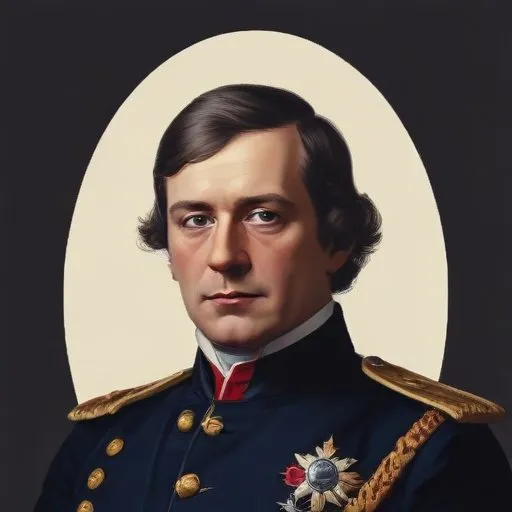
Albrecht von Roon: The Architect of Prussia's Military Supremacy
The Mastermind Behind German Unification
Albrecht von Roon, a renowned Prussian soldier and statesman, is best known for his instrumental role in the unification of Germany under Prussian leadership. Alongside
Otto von Bismarck and Helmuth von Moltke, Roon formed the triumvirate that orchestrated a series of triumphant wars against Denmark, Austria, and France, paving the way for German unification in the 1860s.
Early Life and Education
Born on April 30, 1803, in Pleushagen, Pomerania (now Plena, Poland), Roon hailed from a Flemish family that had settled in Pomerania. Following the death of his father, a Prussian Army officer, during the Napoleonic Wars, Roon was raised by his maternal grandmother. He began his military education at the corps of cadets in Kulm (now Chemno, Poland) in 1816 and later attended the military school in Berlin in 1818.
Rise to Prominence
Roon received his commission in the 14th (3rd Pomeranian) regiment in 1821. He further honed his skills at the General War School in Berlin, where he excelled in military geography under the guidance of
Carl Ritter, a prominent geographer. This expertise led to the publication of his seminal work,
Principles of Physical, National and Political Geography, in three volumes (1826), which garnered widespread recognition.
Minister of War and Architect of Military Reform
Roon's appointment as Minister of War in 1859 marked the beginning of his most influential period. He implemented sweeping reforms to modernize the Prussian Army, introducing innovative tactics, equipment, and training methods. His emphasis on military efficiency and preparedness laid the foundation for Prussia's future military successes.
Military Triumphs and German Unification
Roon played a crucial role in the wars of the 1860s, which ultimately led to German unification. He worked in tandem with Bismarck and Moltke to orchestrate victories against Denmark (1864), Austria (1866), and France (1870-1871). Prussia's military supremacy and strategic alliances enabled the formation of the North German Confederation, paving the way for the creation of the German Empire in 1871.
Legacy and Impact on Modern Society
Roon's contributions to military modernization, geostrategic thinking, and nation-building have left an indelible mark on European history. His commitment to education and military reform has inspired generations of military leaders and strategists. As a testament to his enduring influence, Roon's name has become synonymous with Prussian military excellence and German unity.
Personal Milestones and Anecdotes
- Roon was known for his humility, simplicity, and dedication to duty, earning the respect of his contemporaries and soldiers alike.
- Despite his impressive military achievements, Roon remained humble, attributing his success to the collective efforts of his team.
- Roon's mentorship of future military leaders, including Helmuth von Moltke, ensured the continuity of Prussia's military excellence.
Quotes and Memorable Sayings
- "The army is the backbone of the state, and the state is the army's scaffold."
- "A strong army is the best guarantee of peace."
Historical Context and Legacy
Roon's life and achievements are nestled within the tumultuous landscape of 19th-century Europe, marked by nationalism, wars, and shifting alliances. His legacy serves as a testament to the power of strategic thinking, military innovation, and nation-building. As a pioneer of modern warfare, Roon's influence extends beyond the realm of military history, shaping the course of European politics and international relations.
Awards and Honors
Roon was awarded the highest honors for his military achievements, including the Order of the Black Eagle and the Iron Cross.
Trivia and Fun Facts
- Roon's Principles of Physical, National and Political Geography became a standard textbook in the Prussian Army.
- He was an avid reader and collector of books, with a personal library of over 10,000 volumes.
By examining Roon's remarkable life and achievements, we gain insight into the complex dynamics of European history, the evolution of modern warfare, and the triumph of German unification. Albrecht von Roon's enduring legacy continues to inspire and educate military strategists, historians, and enthusiasts alike.