


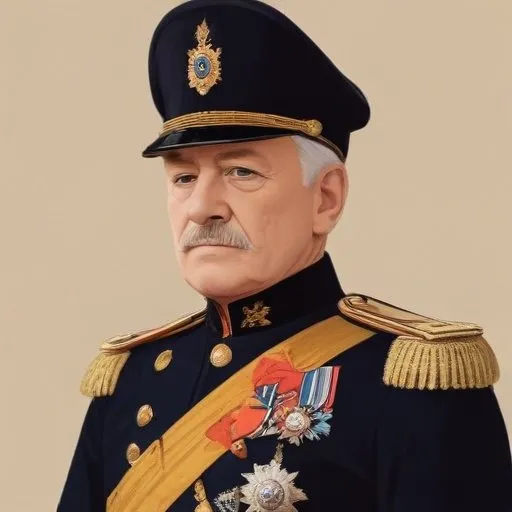
A renowned Prussian military strategist, he's credited with modernizing the Prussian army and leading it to several victories, earning him the nickname "the Elder" to distinguish him from his nephew.
Regarded as one of the greatest military minds of his generation, Helmuth von Moltke the Elder was a Prussian field marshal who revolutionized the art of warfare with his innovative tactics and strategies. As the chief of staff of the Prussian Army for thirty years, Moltke left an indelible mark on the history of warfare, earning him the reputation as the creator of a new, more modern method of directing armies in the field.
Born on October 26, 1800, in Parchim, Mecklenburg-Schwerin, Moltke was the son of a German Generalleutnant in Danish service. After a tumultuous childhood, marked by financial hardship and uncertainty, Moltke resolved to enter the Prussian service, despite the loss of seniority. He became a second lieutenant in the 8th Infantry Regiment stationed at Frankfurt an der Oder in 1822.
Moltke's military prowess was evident early on, and he quickly rose through the ranks. In 1833, he became a member of the Prussian General Staff, where he developed his signature style of warfare, emphasizing speed, mobility, and decisive action. His innovative approach to warfare earned him the respect and admiration of his peers, and he became a trusted advisor to King Frederick William IV of Prussia.
Moltke's most significant contributions to warfare were his pioneering use of railways and telegraphs to coordinate military operations. He recognized the potential of these emerging technologies to revolutionize the speed and efficiency of military communication and transportation. This foresight enabled the Prussian Army to respond quickly to changing circumstances on the battlefield, giving them a decisive advantage over their opponents.
Moltke's military campaigns were marked by a series of decisive victories, including the Second Schleswig War, Austro-Prussian War, and Franco-Prussian War. His tactical genius and ability to adapt to changing circumstances earned him the respect of his enemies and the admiration of his allies.
Moltke's influence on modern warfare is immeasurable. He embodied the Prussian military tradition, and his writings on military strategy continue to be studied by military academies around the world. His legacy extends beyond the military, as his pioneering use of technology and innovative approach to problem-solving have inspired generations of entrepreneurs, inventors, and thinkers.
"The tactical result of an engagement forms the base for new strategic decisions, because it changes the situation to an extent that is not always clearly understood."
Moltke's life and legacy serve as a testament to the power of innovation, strategic thinking, and determination. As one of the most influential military minds in history, his impact continues to be felt to this day.
Born in 1760
A highly influential Prussian military strategist who reformed the Prussian army and played a key role in defeating Napoleon, earning him a legendary status in military history.
Born in 1803
A skilled military strategist and politician who modernized the Prussian army and played a key role in unifying Germany under Prussian leadership. He's remembered for his military reforms and role in shaping modern Germany.
Born in 1815
Unified Germany's founder, a master strategist who forged a nation through diplomacy and war, leaving a lasting legacy in European politics.
Born in 1820
A 19th-century philosopher and economist who co-authored "The Communist Manifesto" with Karl Marx, shaping modern socialist and communist thought. He also wrote extensively on economics, history, and politics.
Born in 1818
A 19th-century philosopher who developed the theory of communism, arguing that capitalism would eventually be replaced by a socialist society. He's known for his critique of capitalism and the concept of class struggle.
Born in 1755
A pioneering military reformer who modernized the Prussian army and played a key role in the Napoleonic Wars, known for his innovative tactics and strategic thinking.
