


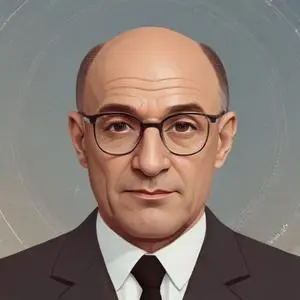
Developed the Friedmann equations, which describe the expansion of the universe, and proposed the idea of an expanding universe, challenging the prevailing static universe model.
Imagine a universe that is constantly expanding, where galaxies are moving away from each other at an incredible pace. This groundbreaking concept, which revolutionized the field of cosmology, is the brainchild of Russian physicist and mathematician Alexander Friedmann. Born in 1888, Friedmann's pioneering work on the expanding universe, governed by his famous Friedmann equations, has left an indelible mark on our understanding of the cosmos.
Friedmann was born in St. Petersburg, Russia, to a family of artists and intellectuals. His father, also named Alexander, was a composer and ballet dancer, while his mother, Ludmila, was a pianist. This cultural upbringing instilled in Friedmann a love for learning and a passion for discovery.
Friedmann's academic journey began at St. Petersburg State University, where he obtained his degree in 1910. He later became a lecturer at the Saint Petersburg Mining Institute, where he met his lifelong friend and fellow mathematician, Jacob Tamarkin.
In 1922, Friedmann introduced the concept of an expanding universe, which was met with skepticism by some of the most prominent scientists of the time, including Albert Einstein. Despite the initial resistance, Friedmann's work paved the way for a new understanding of the cosmos, which was later confirmed by observations made by Edwin Hubble in 1929.
Friedmann's theory was built upon his development of the Friedmann equations, a set of mathematical formulas that describe the evolution of the universe. These equations, which are still widely used today, demonstrate that the universe is not static, but rather dynamic and expanding.
Friedmann's life was not limited to academia. During World War I, he fought on behalf of Imperial Russia as an army aviator, an instructor, and eventually, as the head of an airplane factory. This experience not only showcased his bravery but also his ability to adapt to new situations.
In 1925, Friedmann was appointed as the director of the Main Geophysical Observatory in Leningrad, a position that allowed him to continue his research and contribute to the development of geophysics in the Soviet Union.
Alexander Friedmann's work has had a profound impact on our understanding of the universe. His theory of the expanding universe, although initially met with skepticism, has become a cornerstone of modern cosmology. Today, his legacy continues to inspire scientists and researchers around the world.
Friedmann's story serves as a reminder that even the most groundbreaking ideas can be met with resistance, but with perseverance and dedication, they can change the course of human understanding.
As we continue to explore the vast expanse of the universe, we are reminded of the debt we owe to visionaries like Alexander Friedmann, who dared to challenge conventional wisdom and push the boundaries of human knowledge.
Friedmann's story is a testament to the power of human ingenuity and the importance of perseverance in the pursuit of knowledge. His legacy will continue to inspire generations of scientists, researchers, and explorers, as we venture further into the unknown.
Born in 1879
A brilliant physicist who developed the theory of relativity and is considered one of the most influential scientists of the 20th century, known for his groundbreaking work in physics and mathematics.
Born in 1908
A renowned physicist and academic who made groundbreaking contributions to our understanding of quantum mechanics, superfluidity, and particle physics, earning a Nobel Prize in Physics in 1962.
Born in 1904
A Ukrainian-American physicist and cosmologist who developed the Big Bang theory and wrote popular science books, making complex concepts accessible to a broad audience.
Born in 1898
Developed quantum mechanics and relativity theories, making significant contributions to our understanding of space and time. His work laid the foundation for modern particle physics and cosmology.
Born in 1921
A Soviet physicist and dissident who advocated for human rights and nuclear disarmament, earning a Nobel Peace Prize in 1975. He's known for his courageous stance against the Soviet regime, promoting peace and democracy.
Born in 1895
A Soviet physicist who developed the concept of the "tokamak," a device used to confine and study plasmas at extremely high temperatures, leading to advancements in nuclear fusion research.
Born in 1894
A Soviet physicist who discovered superfluidity and made significant contributions to the study of low-temperature physics, earning him a Nobel Prize in Physics in 1978.
