


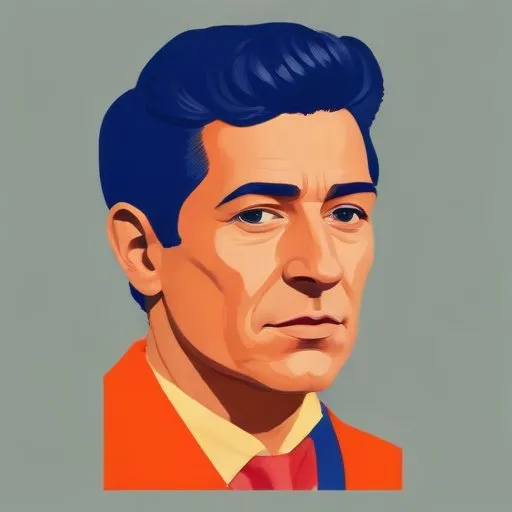
A renowned sculptor and educator, he created iconic works like the Swann Memorial Fountain and taught at the Pennsylvania Academy of Fine Arts, inspiring generations of artists.
Alexander Stirling Calder was a renowned American sculptor and teacher, best known for his iconic works such as the George Washington as President on the Washington Square Arch in New York City, the Swann Memorial Fountain in Philadelphia, and the Leif Eriksson Memorial in Reykjavik, Iceland. His contributions to the world of sculpture and art education have left a lasting impact on modern society.
Alexander Stirling Calder was born on January 11, 1870, in Philadelphia, Pennsylvania, to sculptor Alexander Milne Calder and Margaret Stirling. He attended city public schools and enrolled at the Pennsylvania Academy of the Fine Arts (PAFA) in 1885, at the age of 15.
Calder's career as a sculptor took off in 1892, when he returned to Philadelphia after studying in Europe. His first major commission was for a larger-than-life-size statue of Dr. Samuel Gross (1895-1897) for the National Mall in Washington, D.C.
Alexander Stirling Calder's work not only contributed to the world of art but also had a significant impact on modern society. His sculptures have become iconic landmarks, inspiring generations of artists and art enthusiasts.
In addition to his contributions as a sculptor, Calder was also a dedicated teacher. He taught at the Pennsylvania Academy of the Fine Arts and the Art Students League of New York.
Alexander Stirling Calder's personal life was marked by significant events that shaped his career and artistic vision.
Alexander Stirling Calder's remarkable contributions to the world of art and education have left an indelible mark on modern society. His sculptures continue to inspire and educate, serving as a testament to his lasting legacy.
Born in 1840
A French sculptor and illustrator famous for creating iconic, emotionally charged figures that capture the human experience, including the iconic symbol of intellectualism, The Thinker.
Born in 1876
A pioneer of modernist sculpture, he's renowned for his minimalist, abstract, and avant-garde works that redefined the boundaries of art, pushing the limits of form and materiality.
Born in 1898
A pioneer of modern sculpture, creating abstract, biomorphic forms that evoke a sense of primal emotion, and illustrating books with whimsical, dreamlike drawings.
Born in 1904
A pioneering artist who blended Eastern and Western styles to create innovative sculptures and public spaces that harmonize nature and architecture. Known for iconic designs like the Noguchi coffee table and playgrounds that encourage creative play.
Born in 1887
A pioneering artist who challenged conventional norms by submitting a urinal as art, sparking a revolution in conceptual art and questioning the very definition of art itself.
Born in 1912
Pioneering abstract expressionist artist who splattered and dripped paint to create dynamic, emotive works that redefined modern art. Known for chaotic, intricate pieces that evoke raw emotion.
Born in 1903
A pioneer of abstract expressionism, creating bold, rectangular color fields that evoke emotions and spark introspection. His works are a testament to the power of art to transcend language and culture.
Born in 1905
A pioneer of Abstract Expressionism, creating bold, color-field paintings that evoke emotions and spirituality. His iconic "zip" paintings feature vibrant, vertical stripes that seem to pulse with energy.
