


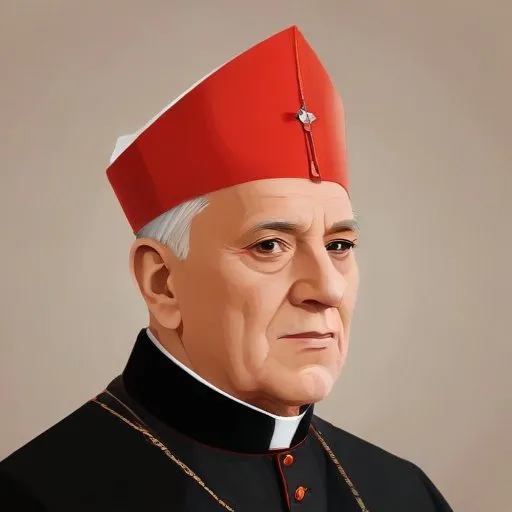
A 17th-century Italian archbishop and cardinal who played a significant role in the Roman Catholic Church, known for his involvement in the papal conclave of 1676.
Alfonso Litta, a prominent Italian nobleman, is renowned for his esteemed role as Cardinal and Archbishop of Milan from 1652 to 1679. During his tenure, he made significant contributions to the Catholic Church, implementing crucial reforms and playing a pivotal role in shaping the religious landscape of Milan.
Born on September 19, 1608, in Milan, Alfonso Litta was the second child of Marquess Pompeo of the House of Litta. Following his mother's remarriage to Antonio Ferrer, the great chancellor of the Duchy of Milan, Alfonso relocated to Spain, where he studied canon law at the University of Salamanca. He later completed his studies, earning a doctorate in utroque iure, at the University of Bologna in 1628.
In 1628, Alfonso entered the order of lawyers of Milan and the clerical state in 1630. His career began to take shape as he moved to Rome, where Pope Urban VIII appointed him referendary of the Tribunals of the Apostolic Signature. This marked the beginning of his ascent in the Catholic Church hierarchy.
Alfonso's administrative prowess was soon recognized, and he served as governor of various cities, including Orvieto, Spoleto, Camerino, and Bologna. His dedication to the papal army earned him the position of commissary general in 1643. During the revolt of Masaniello, he played a crucial role as governor of the Campagne and Maritime Province, siding with the Spanish government and disclosing a French and Barberini scheme.
On June 17, 1652, Alfonso Litta was appointed Archbishop of Milan, a position he held until his death in 1679. He was consecrated bishop on June 24, 1652, in Rome by Cardinal Giulio Roma, and made his entrance in Milan as Archbishop on November 17, 1652.
As bishop, Alfonso Litta followed in the footsteps of Saint Charles Borromeo, convening two diocesan synods in 1659 and 1669. He made pastoral visits to the pieves far away from Milan, ensuring the spiritual well-being of his flock. Alfonso was a guardian of the Ambrosian rite, and in 1679, he edited some editions of the Missal and of the Breviary.
Alfonso Litta's contributions to the Catholic Church and the city of Milan have left an indelible mark. His commitment to the Ambrosian rite and his role in shaping the religious landscape of Milan continue to inspire generations. As a testament to his legacy, the city of Milan honors his memory, recognizing him as one of its most influential figures.
Alfonso Litta's life and career serve as a testament to the enduring legacy of a devoted servant of the Catholic Church. His vision, leadership, and commitment to his faith continue to inspire and shape the spiritual landscape of Milan to this day.
Born in 1499
Reigned from 1559 to 1565, this Pope oversaw the final session of the Council of Trent, shaping Catholic doctrine and practice for centuries to come. He also commissioned the construction of the Sistine Chapel's dome.
Born in 1810
The first pope to fully embrace modernity, he issued the groundbreaking encyclical Rerum Novarum, which addressed social justice and workers' rights, shaping the Catholic Church's stance on social issues.
Born in 1504
Leader of the Catholic Church during the Counter-Reformation, he excommunicated Queen Elizabeth I and played a key role in the Council of Trent.
Born in 1675
A 18th-century pope who reformed the Catholic Church, promoting tolerance and scholarship, and is known for his encyclicals on topics like usury and the sacraments.
Born in 1876
The leader of the Catholic Church from 1939 to 1958, known for his controversial role during World War II, particularly in regards to the Holocaust. He is also remembered for his encyclicals on social justice and liturgical reforms.
Born in 1876
The leader of the Catholic Church from 1939 to 1958, known for his controversial role during World War II, particularly in regards to the Holocaust. He is also remembered for his encyclicals on social justice and liturgical reforms.
Born in 1881
Reformed the Catholic Church, introducing progressive reforms and ecumenical dialogue, and convened the Second Vatican Council.
Born in 1417
A 15th-century pope who played a significant role in the fall of the Western Schism, ending the division in the Catholic Church. He's also known for his lavish spending and nepotism.
