


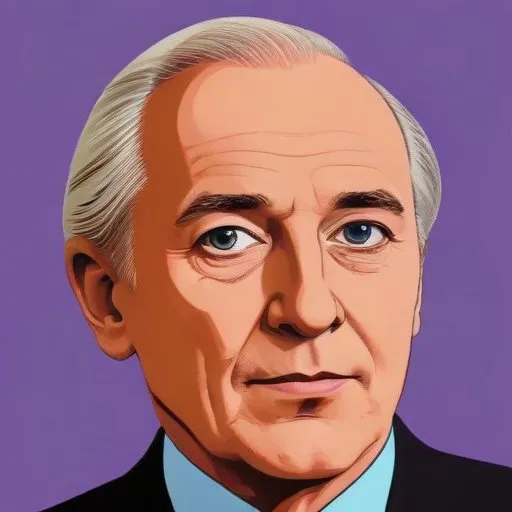
Renowned historian and author of meticulously researched books on French and British history, particularly the Algerian War and the Paris Commune. His works are considered seminal and authoritative in their field.
Alistair Horne, a British historian, and academic, is best known for his in-depth works on armed conflicts involving 19th and 20th-century France, including his magnum opus, A Savage War of Peace, a seminal work on the Algerian War.
Horne was born on 9 November 1925, to Sir Allan Horne and Auriol née Hay-Drummond, niece of the 13th Earl of Kinnoull. His early education took place at Eastacre, Ludgrove School, and subsequently at Millbrook School in the United States, where he befriended the renowned author and conservative commentator, William F. Buckley Jr.
Horne served in the Royal Air Force (RAF) from 1943 to 1944 and later as an officer in the Coldstream Guards from 1944 to 1947. He graduated from Jesus College, Cambridge, as a Master of Arts (MA) and later received the degree of LittD from the University of Cambridge in 1993.
Horne's writing career spanned over four decades, during which he authored more than 20 books on travel, history, and biography. His works include The Price of Glory: Verdun 1916, To Lose a Battle: France 1940, and The Fall of Paris: The Siege and the Commune 1870-71, among others. His comprehensive research and engaging narrative style have made him a prominent historian of his time.
In recognition of his contributions to Anglo-French relations, Horne was knighted in the Queen's Birthday Honours in 2003. He was also a senior member at St Antony's College, Oxford, and a fellow of the college from 1978 until his death in 2017.
Horne was married twice, first to Renira Hawkins in 1953, with whom he had three daughters, and later to Sheelin Lorraine Ryan in 1987, an artist and former wife of Simon Eccles, son of David Eccles, 1st Viscount Eccles. He resided at Turville, Buckinghamshire, where he was known for his strong opposition to the opening of a Montessori school adjacent to his home.
Alistair Horne's works have left an indelible mark on the world of historiography, offering a nuanced understanding of the complex web of international relations and conflicts that shaped the modern world. His legacy continues to inspire historians, scholars, and readers alike, ensuring that his contributions to the field of history remain timeless and profound.
Born in 1894
A British politician who served as Prime Minister from 1957 to 1963, known for leading the country through a period of economic prosperity and decolonization.
Born in 1871
Prolific writer of historical novels and adventure stories, also a talented landscape painter.
Born in 1897
A British politician who served as Prime Minister from 1955 to 1957, known for his role in the Suez Crisis and his diplomatic efforts during the Cold War.
Born in 1863
A Welsh lawyer and politician who served as Prime Minister of the United Kingdom, leading the country through World War I and introducing key social reforms. He's known for his charismatic leadership and progressive policies.
Born in 1869
The Prime Minister who infamously appeased Nazi Germany with the Munich Agreement, hoping to avoid war, but ultimately contributing to its outbreak. He's a symbol of failed diplomacy and naivety in the face of aggression.
Born in 1867
A conservative leader who served as Prime Minister three times, known for his role in navigating Britain through economic crises and advocating for imperial protectionism.
Born in 1866
A Scottish journalist and politician who served as the first Labour Party Prime Minister of the United Kingdom, leading the country through significant economic and social reforms. He is also known for his efforts to maintain peace in Europe during the interwar period.
Born in 1883
Led the Labour Party to a landslide victory in 1945, implementing significant social and economic reforms, including the creation of the National Health Service. He played a crucial role in shaping post-war Britain.
